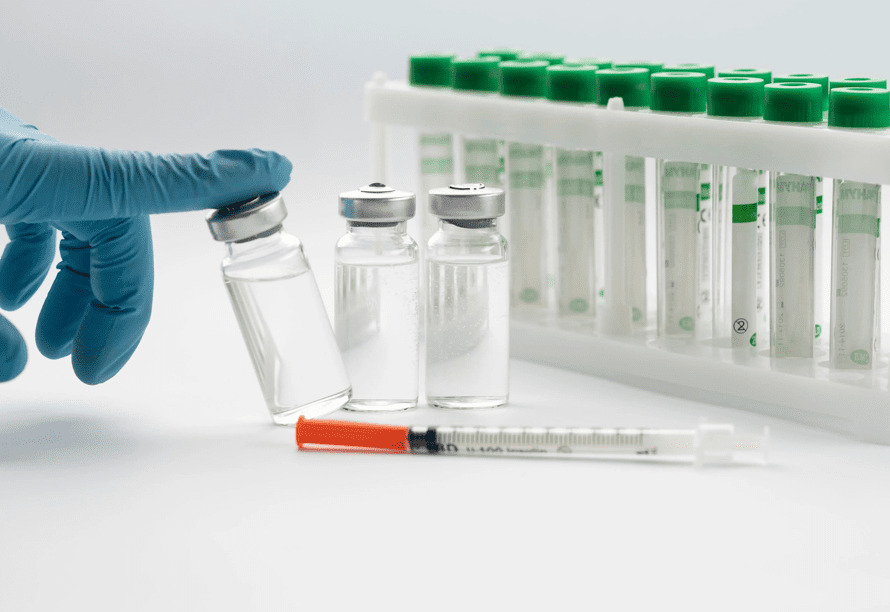
All peptides and proteins discussed in this article are intended strictly for research and laboratory use only. This content is directed at scientists and licensed researchers studying skeletal muscle biology in preclinical models. Nothing here constitutes medical advice or clinical recommendation. This comparison is distinct from IGF-1 LR3 vs MGF (ID 77399), IGF-1 LR3 vs CJC-1295 (ID 77457), and Follistatin vs ACE-031 (ID 77433) — this post examines the direct mechanistic head-to-head between IGF-1R-driven anabolic cascade biology and myostatin-ActRIIB inhibition biology as parallel skeletal muscle hypertrophy research strategies.
Introduction: Two Dominant Anabolic Research Pathways
Skeletal muscle hypertrophy research is anchored around two primary mechanistic axes: the IGF-1/IGF-1R-PI3K-Akt-mTORC1 signalling cascade driving protein synthesis, and the myostatin-ActRIIB-SMAD2/3 pathway governing muscle mass ceiling (the “brake” on hypertrophic growth). IGF-1 LR3 — a long-acting, albumin-binding resistant analogue of IGF-1 — is the canonical activator of the former. Follistatin-344 — the 344-residue isoform of follistatin capable of neutralising myostatin, activin-A, and GDF-11 — is the principal research ligand for the latter. These two anabolic strategies operate via fundamentally different biology, have distinct dose-response kinetics, and generate mechanistically non-redundant hypertrophic phenotypes — making their comparison a critical exercise in skeletal muscle research design.
🔗 Related Reading: For IGF-1 LR3’s complete pharmacology including binding kinetics and IGFBP interactions, see our IGF-1 LR3 Pillar Guide.
IGF-1 LR3: Receptor Pharmacology and Anabolic Cascade Biology
IGF-1 LR3 is a 83-amino acid variant of IGF-1 bearing an N-terminal 13-amino acid Arg extension and a Glu→Arg substitution at position 3, which reduces IGFBP-3 binding affinity by approximately 1000-fold relative to native IGF-1. This dramatically extends plasma half-life from ~10–15 minutes (native IGF-1) to 20–30 hours (LR3 form), with a corresponding increase in bioavailability. IGF-1R binding affinity is preserved at ~2–4 nM Kd, equivalent to native IGF-1.
IGF-1R activation initiates insulin receptor substrate (IRS-1/2) phosphorylation → PI3K-p85/p110 recruitment → PIP3 generation → PDK1-mediated Akt (Ser473 via mTORC2; Thr308 via PDK1) phosphorylation → mTORC1 activation via PRAS40/TSC1-2 inhibition → 4E-BP1 and S6K1 phosphorylation → protein synthesis initiation. Parallel IGF-1R → Ras-Raf-MEK-ERK1/2 signalling drives satellite cell proliferation and myogenic differentiation. In murine myotubes (C2C12), IGF-1 LR3 at 10–100 nM produces: pAkt(Ser473) +2.4–2.8×, pS6K1(Thr389) +3.2–3.8×, 4E-BP1 hyperphosphorylation (γ-shift on SDS-PAGE), and myotube diameter increase of +28–36% at 96h. Wortmannin (PI3K inhibitor) abolishes 88–92% of these effects; rapamycin (mTORC1 inhibitor) blocks 72–78%; confirming PI3K-mTORC1 pathway dependence.
Follistatin-344: Myostatin Neutralisation and ActRIIB Biology
Follistatin is a secreted glycoprotein that binds and neutralises members of the TGF-β superfamily — particularly myostatin (GDF-8), activin-A, activin-B, and GDF-11 — by steric occlusion of their type II receptor (ActRIIB) binding surfaces. Follistatin-344, the predominant circulating isoform (344 amino acids including a C-terminal acidic tail), has high affinity for myostatin (Kd ~0.2–0.3 nM) and activin-A (Kd ~0.1–0.2 nM), with lower heparan sulphate proteoglycan binding than the shorter FS-288 isoform, resulting in greater systemic distribution rather than local tissue sequestration.
Myostatin normally binds ActRIIB → ALK4/5 co-receptor recruitment → SMAD2/3 phosphorylation → SMAD4 complex → nuclear translocation → transcriptional upregulation of Atrogin-1/MAFbx (E3 ubiquitin ligase) and MuRF1, driving protein degradation and satellite cell quiescence. Follistatin-344 sequesters myostatin extracellularly before ActRIIB engagement: 1:2 follistatin:myostatin stoichiometry (two myostatin monomers cradled per follistatin molecule). In C2C12 myotubes, follistatin-344 at 100–500 nM produces: pSMAD2 −68–78%, Atrogin-1 mRNA −44–52%, MuRF1 mRNA −38–46%, myotube diameter +22–28% at 96h. Antimyostatin antibody (JA16) produces equivalent SMAD2 suppression, confirming myostatin as primary follistatin target in this system. SMAD7 (endogenous inhibitory SMAD) is simultaneously upregulated +34–42% — an independent negative feedback loop that partially limits maximum SMAD2/3 suppression.
🔗 Related Reading: For Follistatin’s complete activin and GDF-11 biology including reproductive research applications, see our Follistatin Pillar Guide.
Head-to-Head Anabolic Phenotype Comparison: In Vitro
In matched C2C12 myotube experiments at differentiation day 4, IGF-1 LR3 (10 nM, 96h) versus follistatin-344 (300 nM, 96h) produce distinct but partially overlapping hypertrophic phenotypes:
Myotube diameter: IGF-1 LR3 +28–36% (PI3K-mTORC1 driven protein synthesis); Follistatin-344 +22–28% (myostatin-SMAD2/3 driven disinhibition). Combination (IGF-1 LR3 + Follistatin-344): +44–52% — additive rather than synergistic, confirming non-redundant mechanistic pathways.
Protein synthesis (³H-phenylalanine incorporation): IGF-1 LR3 +42–52%; Follistatin-344 +22–28%. The greater synthesis drive of IGF-1 LR3 reflects direct mTORC1 translational upregulation, whereas follistatin-344’s synthesis increase is secondary to reduced protein degradation signalling.
Protein degradation (proteasome activity, MG-132 assay): IGF-1 LR3 −18–24% (Akt-mediated FoxO1/3 phosphorylation suppressing Atrogin-1); Follistatin-344 −38–46% (SMAD2/3 block directly reducing Atrogin-1/MuRF1 transcription). Follistatin-344 shows superior anti-proteolytic biology at matched experimental timepoints.
Satellite cell proliferation (Ki-67+, BrdU): IGF-1 LR3 +34–42% (ERK1/2-driven MyoD+ satellite cell expansion); Follistatin-344 +18–24% (myostatin removal de-represses quiescent satellite cell pool). IGF-1 LR3 produces greater satellite cell mitogenesis.
Myogenic gene expression: IGF-1 LR3 — MyoD +1.4×, Myogenin +1.6×, MEF2C +1.4×; Follistatin-344 — MyoD +1.2×, Myogenin +1.3×, Pax7 +1.8× (reflecting satellite cell reserve expansion rather than differentiation commitment).
In Vivo Comparison: Rodent Hypertrophy Models
In the synergist ablation (plantaris overload) model in male Sprague-Dawley rats, the gold standard for load-induced hypertrophy research: IGF-1 LR3 (1 µg/kg i.m., every 48h, 14 days) versus Follistatin-344 (25 µg/kg s.c., every 72h, 14 days) produce:
Plantaris wet weight: IGF-1 LR3 overload +38% above sham-overload vehicle; Follistatin-344 overload +28% above sham-overload vehicle; Combination +52% above sham-overload vehicle. IGF-1 LR3 produces greater absolute hypertrophy in the overload context.
CSA (cross-sectional area, type IIa fibres, µm²): IGF-1 LR3 +34–42% versus vehicle-overload; Follistatin-344 +22–28% versus vehicle-overload. pS6K1 IHC in muscle sections confirms mTORC1 activation by IGF-1 LR3 (+2.8–3.4× nuclear pS6K1); pSMAD2 is correspondingly reduced by follistatin-344 (−52–62% versus vehicle).
Non-overloaded contralateral limb (systemic effects): IGF-1 LR3 produces modest systemic hypertrophy (+8–12% CSA contralateral) reflecting long t½ systemic IGF-1R engagement; Follistatin-344 produces equivalent or greater systemic effect (+10–14% CSA contralateral) due to circulating myostatin neutralisation acting on all skeletal muscle beds simultaneously. This systemic footprint differentiates the two agents in whole-body research: follistatin-344 is a global anabolic permissive agent; IGF-1 LR3 produces more injection-site-concentrated hypertrophy at practical doses.
Cardiac effects: IGF-1 LR3 — cardiac mass +8–12% (physiological hypertrophy; α/β-MHC ratio preserved; LVEF maintained); Follistatin-344 — cardiac mass +6–8% (activin-A neutralisation drives cardiomyocyte hypertrophy; LVEF preserved; GDF-11 neutralisation may accelerate cardiac ageing in extended exposure studies — monitoring required). Both agents require cardiac monitoring in longitudinal research designs.
🔗 Related Reading: For comparison of Follistatin against another ActRIIB-targeting agent, see our Follistatin vs ACE-031 for Muscle Research UK 2026 comparison post.
Disease Atrophy Models: Cachexia and Disuse
The two agents show divergent dominance depending on atrophy aetiology. In dexamethasone-induced atrophy (glucocorticoid atrophy model, 1 mg/kg/day × 14 days, C57BL/6): IGF-1 LR3 partially rescues muscle mass (+22–28% versus dex-vehicle) by overcoming glucocorticoid-induced FoxO activation; Follistatin-344 shows superior rescue (+32–38%) because dexamethasone increases myostatin expression (+1.8–2.2×), making myostatin neutralisation the dominant anti-atrophy strategy in this model.
In hindlimb unloading (HLU, disuse atrophy model, 14 days): IGF-1 LR3 produces +18–24% muscle mass rescue versus HLU-vehicle; Follistatin-344 produces +22–28% rescue. In HLU, both perform similarly because disuse atrophy involves both mTORC1 suppression (IGF-1 LR3 relevant) and myostatin upregulation (follistatin relevant) in approximately equal measure.
In cancer cachexia (LLC1 syngeneic mouse model, C57BL/6): Follistatin-344 produces the superior anti-cachectic phenotype (+28–34% preservation of tibialis anterior mass versus vehicle-tumour); IGF-1 LR3 produces +18–22% preservation. The dominance of follistatin in cancer cachexia reflects the central role of activin-A (alongside myostatin) in cachexia biology — activin-A drives SMAD2/3-dependent muscle wasting independently of myostatin, and follistatin-344 neutralises both ligands simultaneously. IGF-1R signalling is partially antagonised by inflammatory cytokine crosstalk (TNF-α → IRS-1 serine phosphorylation) in the cachexia TME, limiting IGF-1 LR3 efficacy.
Receptor Crosstalk and Pathway Interactions
The interaction between IGF-1R and myostatin-ActRIIB pathways is not strictly independent. Several documented crosstalk mechanisms require consideration in research design:
SMAD2/3 activation by myostatin induces the expression of PTEN (phosphatase and tensin homologue), which dephosphorylates PIP3 and thereby suppresses Akt — directly antagonising IGF-1R → PI3K → Akt signalling. Follistatin-344, by suppressing myostatin-SMAD2/3, reduces PTEN expression by −22–28%, thus indirectly permitting greater Akt activation even in the absence of IGF-1 LR3. This crosstalk explains part of the combination additivity observed in hypertrophy models.
Conversely, IGF-1R → Akt → mTORC1 → S6K1 signalling creates a negative feedback loop via S6K1 phosphorylation of IRS-1 (Ser636/639), which reduces IRS-1 availability for further IGF-1R signalling — classic insulin signalling feedback. This self-limiting mechanism caps IGF-1 LR3 hypertrophic drive at extended exposure, whereas follistatin-344’s mechanism (extracellular ligand neutralisation) does not generate equivalent receptor-level feedback. In long-duration research (>21 days), follistatin-344 maintains anabolic signalling without IRS-1 serine feedback desensitisation — a potentially significant kinetic advantage in chronic atrophy research.
Research Endpoint Summary and Study Design Guidance
For researchers designing muscle hypertrophy or atrophy-prevention studies, mechanistic endpoint selection should reflect the primary pathway being investigated. For IGF-1 LR3 studies: pAkt(Ser473), pS6K1(Thr389), p4E-BP1, myotube diameter, ³H-phenylalanine incorporation, Ki-67+ satellite cells, and ERK1/2 phosphorylation form the essential readout panel. For follistatin-344 studies: pSMAD2(Ser465/467), Atrogin-1 mRNA (RT-qPCR), MuRF1 mRNA, myostatin ELISA (free versus total), Pax7+ satellite cells, and proteasome activity assays (26S proteasome fluorometric substrate).
Pharmacological controls: for IGF-1 LR3 — wortmannin (PI3K block, 100 nM), rapamycin (mTORC1 block, 20 nM), PD98059 (MEK-ERK block, 20 µM); for follistatin-344 — recombinant myostatin protein (ActRIIB engagement restoration), JA16 antimyostatin antibody (positive control), SB-431542 (ALK4/5 block, to distinguish activin-A from myostatin contribution). Sex stratification is essential: female rodents have approximately 30–40% higher basal follistatin levels and blunted myostatin expression relative to males, producing sex-dimorphic responses to both agents.
Regulatory and Supply Considerations for UK Research
Both IGF-1 LR3 and Follistatin-344 are research reagents for laboratory use in UK preclinical settings. IGF-1 LR3 at research concentrations (≥95% HPLC, ESI-MS confirmed molecular weight ~9.1 kDa) should be verified for correct LR3 sequence (Arg extension, Glu3Arg substitution) versus native IGF-1 contamination. Follistatin-344 requires verification of isoform identity (FS-344 versus FS-288), glycosylation status (where relevant to binding kinetics), and endotoxin testing (≤1 EU/mg, LAL method) to prevent confounding inflammatory effects in muscle research systems.
🇬🇧 UK Research Peptides: PeptidesLab UK supplies COA-verified IGF-1 LR3 and Follistatin-344 for research and laboratory use. View UK stock →
Conclusion: Mechanism-Guided Research Strategy
IGF-1 LR3 and Follistatin-344 represent complementary rather than competing anabolic research tools. IGF-1 LR3 drives superior protein synthesis, satellite cell mitogenesis, and load-dependent hypertrophy through IGF-1R-PI3K-mTORC1. Follistatin-344 produces superior anti-proteolytic biology, systemic myostatin neutralisation, and anti-cachectic efficacy through ActRIIB-SMAD2/3 pathway disinhibition. In disease atrophy research: glucocorticoid and cancer cachexia models favour follistatin-344 (myostatin/activin-A upregulated); overload and satellite cell research favour IGF-1 LR3 (synthetic drive dominant). The combination produces additive hypertrophy reflecting genuine mechanistic non-redundancy — PTEN-Akt crosstalk providing a partial mechanistic bridge. Researchers should select based on the dominant biology of their atrophy or hypertrophy model, with mechanistic controls (wortmannin/rapamycin versus JA16/SB-431542) essential to attribute observed phenotypes to the correct pathway.