









No products in the cart.

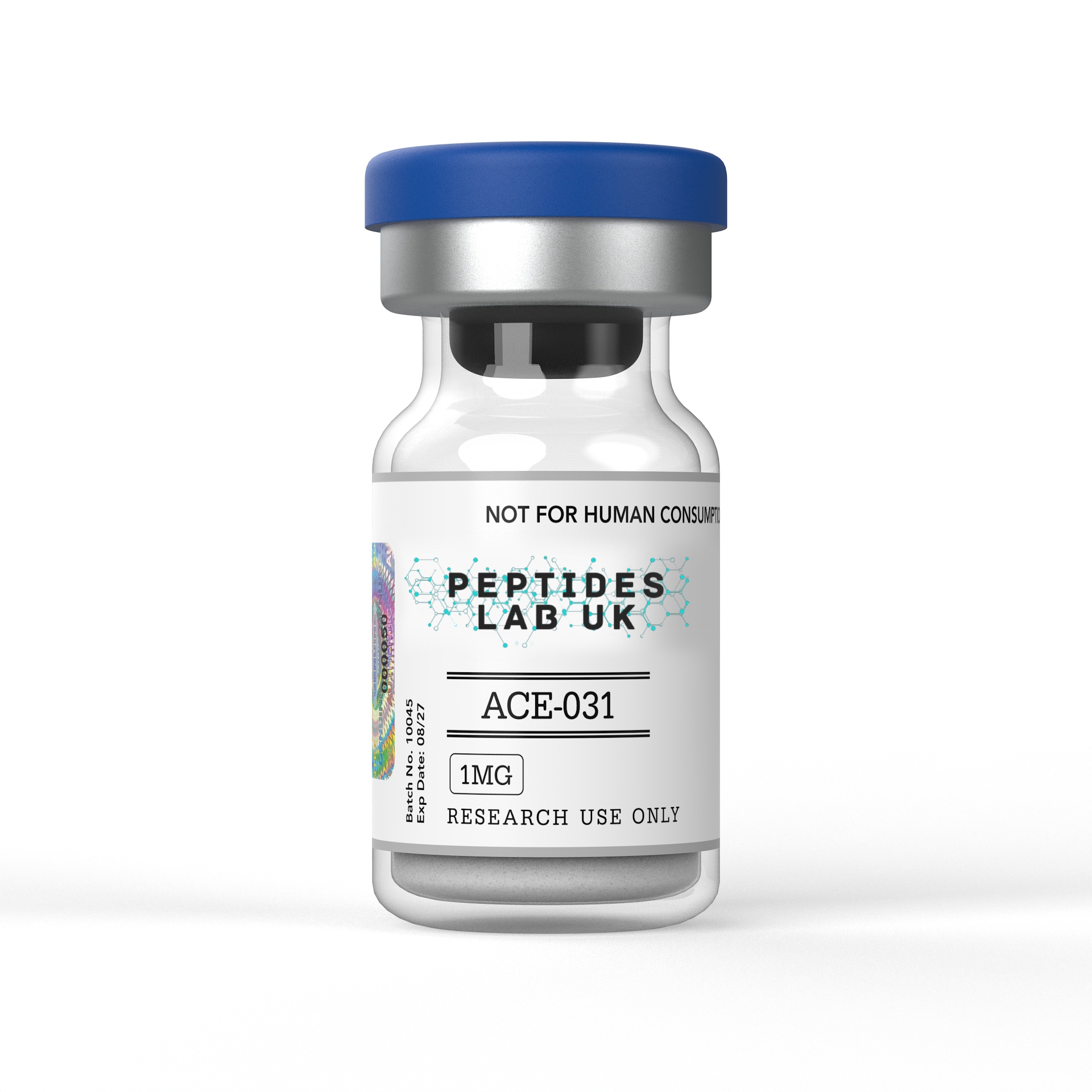
Buy ACE-031 For Lab Research
£79.99
Login for member prices★★★★★
✔︎ Quality checked
✔︎ Third party verified
ACE-031 is an activin receptor type IIB (ActRIIB) inhibitor peptide for laboratory and in vitro research. Supplied at high purity with a full third-party COA. For laboratory and in vitro research use only. Not for human consumption. Not a medicine.

Looking for a Certificate of Analysis?
If you are looking for a Certificate Of Analysis, please email research@peptideslabuk.com to have it sent to you.
Please Note: Many sites are displaying counterfeit COAs, so ours is provided upon request.
If you are looking for a Certificate Of Analysis, please email research@peptideslabuk.com to have it sent to you.
Please Note: Many sites are displaying counterfeit COAs, so ours is provided upon request.
You may also like…
-
Login for member prices

-
Login for member prices
-
Login for member prices
Product Description
ACE-031 | Buy ACE-031 UK | Ramatercept | ActRIIB Fusion Protein | Myostatin Inhibitor | Research Use Only
ACE-031 — also known as Ramatercept and ACVR2B/Fc — is a recombinant fusion protein comprising the extracellular domain of activin receptor type IIB (ActRIIB / ACVR2B) linked to a human IgG1-Fc region, engineered to act as a soluble decoy receptor that binds and neutralises myostatin (GDF-8), activins, GDF-11, and other TGF-β superfamily ligands that negatively regulate skeletal muscle mass — making it the most broadly characterised ActRIIB-based myostatin inhibitor in pre-clinical and clinical research, with a well-documented pharmacodynamic profile across muscle mass, bone mineral density, and fat metabolism research models. Buy ACE-031 in the UK from Peptides Lab UK with >99% HPLC-verified purity, batch-specific COA, and fast UK dispatch for laboratory and in vitro research use only.
Distributed by Peptides Lab UK in lyophilised format for controlled laboratory research. Each batch is independently verified for purity. This compound is handled strictly in pre-clinical settings with no applications in human or veterinary medicine.
What Is ACE-031?
ACE-031 (Ramatercept) is a recombinant fusion protein — not a conventional small-molecule peptide — developed by Acceleron Pharma in collaboration with Shire. It consists of the ligand-binding extracellular domain of the type IIB activin receptor (ACVR2B / ActRIIB) fused to a human IgG1-Fc region to extend circulating half-life and improve stability. The resulting construct behaves as a soluble decoy receptor: it circulates freely and competitively binds TGF-β superfamily ligands before they can engage their endogenous membrane-bound ActRIIB receptors on muscle cells, bone, and other tissues.
Unlike myostatin-specific monoclonal antibodies — which target only GDF-8 — ACE-031 binds the full spectrum of ActRIIB-activating ligands, including myostatin (GDF-8), activin A, activin B, GDF-11, and BMP-9/BMP-10. This broad-spectrum ligand sequestration is both ACE-031’s principal research strength and the origin of its most significant safety signal: cross-inhibition of BMP-9 and BMP-10 (which regulate endothelial cell function via ALK1 signalling) was identified as the probable cause of the vascular adverse events that led to early clinical trial termination.
ACE-031’s well-characterised pharmacology — including a defined half-life of 10–15 days, dose-dependent lean mass and bone density effects, and an extensively studied safety profile — makes it a uniquely informative research tool for studying the ActRIIB ligand network and its roles in musculoskeletal biology.
Also Known As
- Ramatercept
- ACVR2B/Fc
- ActRIIB-IgG1
- Soluble ActRIIB
- ACE031
How Does ACE-031 Work?
Soluble Decoy Receptor Mechanism
ACE-031 functions as a circulating ligand trap. Its ACVR2B extracellular domain retains full binding affinity for the natural ActRIIB ligand repertoire, meaning it competes directly with membrane-bound ActRIIB receptors for available ligand. When ACE-031 binds myostatin or activin A, those ligands are sequestered in the circulation and rendered unable to engage the cell-surface receptors that would otherwise trigger downstream SMAD2/3 signalling to suppress muscle protein synthesis and promote muscle catabolism.
Myostatin (GDF-8) Neutralisation
Myostatin — formally growth differentiation factor 8 (GDF-8) — is a member of the TGF-β superfamily and the primary endogenous brake on skeletal muscle hypertrophy and hyperplasia. Myostatin signals through ActRIIB, recruiting ALK4 or ALK5 as co-receptors and activating SMAD2/3 phosphorylation, which drives transcription of atrophy-related genes and suppresses the PI3K/Akt/mTOR anabolic pathway. By sequestering myostatin before it can bind ActRIIB, ACE-031 releases this suppression — allowing skeletal muscle to respond more robustly to anabolic signals.
Broader TGF-β Superfamily Ligand Sequestration
Research has confirmed that the incremental muscle mass gains achieved with a soluble ActRIIB construct (such as ACE-031) significantly exceed those achievable with myostatin-specific neutralising antibodies alone — establishing that activin A and GDF-11 make meaningful, additive negative contributions to muscle mass regulation alongside myostatin. This multi-ligand sequestration profile is a key reason ACE-031 is used as a pan-ActRIIB research probe, rather than as a myostatin-only tool.
SMAD2/3 Pathway Suppression and Anabolic Disinhibition
By blocking ActRIIB activation across its ligand repertoire, ACE-031 suppresses canonical SMAD2/3 signalling in skeletal muscle. This relieves transcriptional suppression of anabolic muscle genes and allows the PI3K/Akt/mTOR axis — the central driver of muscle protein synthesis, hypertrophy, and satellite cell activation — to operate without TGF-β superfamily-mediated inhibition. The result in pre-clinical models is a combination of muscle fibre hypertrophy, and in some models, evidence of hyperplasia.
Bone Mineral Density Effects
ActRIIB signalling regulates osteoclast and osteoblast activity. ACE-031 treatment in research models has been associated with increased bone mineral density, reduced circulating markers of bone resorption (collagen telopeptide), and increased alkaline phosphatase — suggesting a concurrent effect on bone remodelling that is mechanistically distinct from its muscle effects and reflects ActRIIB’s regulatory role across musculoskeletal biology.
Fat Metabolism and Adipokine Modulation
Research observations with ACE-031 in human volunteers demonstrated reductions in leptin concentration and increases in adiponectin alongside decreases in fat mass — pointing to an adipose-regulatory component that may reflect the ActRIIB ligand network’s broader influence over metabolic homeostasis and body composition beyond skeletal muscle.
BMP-9/BMP-10 Cross-Inhibition — The Critical Safety Context
The premature termination of ACE-031’s clinical development was attributed to adverse vascular events — including telangiectasia, nosebleeds, and gum bleeding — that emerged at higher doses and were mechanistically linked to off-target sequestration of BMP-9 and BMP-10. These two BMPs signal through ALK1 on endothelial cells to maintain vascular integrity and quiescence; their inhibition by a broad ActRIIB decoy is not a therapeutic target but an unavoidable consequence of the receptor’s natural ligand promiscuity. This mechanism is now a central research question in the broader field of ActRIIB-based therapeutics and informs the design of next-generation myostatin inhibitors with improved selectivity.
What Does ACE-031 Do in Research?
In laboratory and pre-clinical settings, ACE-031 has been studied as the definitive broad-spectrum ActRIIB ligand trap and myostatin inhibitor for musculoskeletal biology research. Applications include:
- Myostatin (GDF-8) biology — ActRIIB binding, SMAD2/3 pathway suppression, and muscle mass regulation
- Pan-ActRIIB ligand network research — activin A, activin B, GDF-11, GDF-8, and multi-ligand contribution to muscle mass regulation
- Skeletal muscle hypertrophy and hyperplasia — fibre type-independent muscle mass increases, satellite cell activity, and anabolic pathway disinhibition
- Muscle wasting and cachexia models — DMD, ALS, cancer cachexia, sarcopenia, and disuse atrophy pre-clinical models
- Duchenne muscular dystrophy (DMD) research — mdx mouse models, ambulatory capacity, lean mass, and functional outcome measures
- Bone mineral density and remodelling — osteoclast/osteoblast balance, collagen telopeptide reduction, alkaline phosphatase, and femoral/vertebral density studies
- Body composition research — lean mass quantification by DXA/MRI, fat mass reduction, and body composition remodelling
- Adipokine biology — leptin reduction, adiponectin upregulation, and metabolic consequence of ActRIIB ligand blockade on adipose tissue
- ActRIIB signalling pathway pharmacology — SMAD2/3, ALK4/ALK5 co-receptor biology, and PI3K/Akt/mTOR disinhibition
- Muscle oxidative capacity and fatigability — PGC-1α, PPARβ, PDK4 regulation, mitochondrial function, and ActRIIB’s role in oxidative fibre metabolism
- BMP-9/BMP-10-ALK1 endothelial biology — vascular integrity signalling, endothelial quiescence, and the mechanistic basis of ActRIIB broad-spectrum ligand trap vascular safety signals
- FSH and reproductive endocrinology — activin-dependent FSH regulation, ActRIIB’s role in the reproductive axis, and gonadotropin suppression modelling
- Myostatin inhibitor pharmacology comparison — ACE-031 vs myostatin-specific antibodies, Follistatin 344, and next-generation selective ActRIIB ligand traps
- Cancer biology — ACVR2B receptor dysfunction in colorectal and prostate cancer models, ActRIIB’s tumour suppressor-adjacent biology
- Anti-doping research — ActRIIB fusion protein detection methodology and WADA-prohibited compound analytical development
What Do Studies Say About ACE-031?
Single Ascending-Dose Clinical Study — Healthy Postmenopausal Women
The pivotal phase I study by Attie et al. (2013) published in Muscle & Nerve evaluated ACE-031 across a dose range of 0.02–3 mg/kg in 48 healthy postmenopausal women. The study confirmed a linear pharmacokinetic profile with a mean half-life of 10–15 days. At 3 mg/kg, statistically significant increases in total body lean mass of 3.3% (DXA; p=0.03) and thigh muscle volume of 5.1% (MRI; p=0.03) were observed at day 29. Significant changes in serum biomarkers of bone metabolism and fat were also reported. The 3 mg/kg group also showed a near-maximal 43% suppression of serum FSH — establishing the activin pathway’s role in gonadotropin regulation as a key off-target consideration in ACE-031 research models.
DMD Clinical Trial — Ambulatory Boys
The randomised, placebo-controlled trial by Campbell et al. (2017) in Muscle & Nerve evaluated ACE-031 in ambulatory boys with Duchenne muscular dystrophy. The study reported pharmacodynamic trends for improvements in lean mass, fat mass, and bone mineral density, as well as trends in the 6-minute walk test (6MWT). However, non-muscle-related adverse events — including telangiectasia, nosebleeds, and gum bleeding attributable to BMP-9/BMP-10 cross-inhibition — contributed to the decision to discontinue the study before completion, generating the safety dataset that now informs next-generation ActRIIB ligand trap design across the field.
Soluble ActRIIB Receptor — Fibre Type-Independent Muscle Growth
The pre-clinical study by Cadena et al. (2010) in the Journal of Applied Physiology confirmed that administration of a soluble activin type IIB receptor (the construct on which ACE-031 is based) produced skeletal muscle growth that was independent of fibre type — affecting both slow-twitch (type I) and fast-twitch (type II) fibres equally. This is a key pharmacological distinction from approaches that selectively target specific fibre populations and establishes ACE-031 as a pan-fibre anabolic research tool.
ActRIIB Signalling and Muscle Oxidative Capacity
Research by Relizani et al. (2014) in Molecular Therapy established that blockade of ActRIIB signalling reduces skeletal muscle capillarisation and modulates key metabolic regulators — including PPARβ, PGC-1α, and PDK4 — demonstrating that ActRIIB has a broader role in governing muscle oxidative capacity and fatigability beyond simple mass regulation, and establishing a metabolic trade-off consideration in ActRIIB-targeting research strategies.
Myostatin vs Broad ActRIIB Blockade — A Key Research Distinction
The published evidence base confirms that soluble ActRIIB constructs produce significantly greater muscle mass increases than myostatin-specific antibodies. In myostatin knockout mice, additional muscle mass gains were still achievable by introducing soluble ActRIIB — confirming that activin A, GDF-11, and other ligands make meaningful independent contributions to muscle mass suppression beyond myostatin alone, and establishing ACE-031 as the appropriate research tool when the full ActRIIB ligand network is the experimental variable.
Key Cited Studies
- Attie KM et al. (2013) — A single ascending-dose study of muscle regulator ACE-031 in healthy volunteers. Muscle & Nerve 47(3):416–423. DOI: 10.1002/mus.23539. PMID: 23169607
- Campbell C et al. (2017) — Myostatin inhibitor ACE-031 treatment of ambulatory boys with Duchenne muscular dystrophy: Results of a randomized, placebo-controlled clinical trial. Muscle & Nerve 55(4):458–464. DOI: 10.1002/mus.25268. PMID: 27462804
- Cadena SM et al. (2010) — Administration of a soluble activin type IIB receptor promotes skeletal muscle growth independent of fiber type. J Appl Physiol 109(3):635–642. DOI: 10.1152/japplphysiol.00866.2009
- Relizani K et al. (2014) — Blockade of ActRIIB signaling triggers muscle fatigability and metabolic myopathy. Mol Ther 22(8):1423–1433. DOI: 10.1038/mt.2014.91. PMID: 24828073
- Suh J & Lee YS (2020) — Myostatin inhibitors: Panacea or predicament for musculoskeletal disorders? J Bone Metab 27(3):151–165. DOI: 10.11005/jbm.2020.27.3.151. PMC7502666
ACE-031 vs Other Myostatin Inhibitors in Research
| Feature | ACE-031 (Ramatercept) | Follistatin 344 | MYO-029 (Stamulumab) | Anti-Myostatin Ab (e.g. Landogrozumab) |
|---|---|---|---|---|
| Compound Type | Recombinant fusion protein (ActRIIB-IgG1-Fc) | Naturally occurring glycoprotein | Humanised monoclonal antibody | Monoclonal antibody |
| Ligand Specificity | Broad — myostatin, activin A/B, GDF-11, BMP-9/10 | Broad — myostatin, activins, BMPs, GDF-11 | Myostatin (GDF-8) selective | Myostatin (GDF-8) selective |
| Mechanism | Soluble decoy receptor — circulating ligand trap | Competitive binding — broad TGF-β ligand sequestration | Monoclonal antibody — GDF-8 neutralisation | Monoclonal antibody — GDF-8 neutralisation |
| Half-Life | 10–15 days | ~3 days | ~28 days | ~28 days |
| Muscle Mass Effect | Strong — fibre type-independent hypertrophy | Strong — muscle and reproductive tissue effects | Weak — no significant strength gain in clinical trials | Moderate |
| Bone Density Effect | Yes — significant BMD increase | Limited evidence | Not established | Not established |
| FSH Suppression | Yes — 43% suppression at 3mg/kg | Yes — via activin suppression | No | No |
| BMP-9/10 Off-Target | Yes — vascular adverse events (clinical trial terminated) | Partial | No | No |
| Clinical Development Status | Terminated (vascular AEs) | Not clinically developed | Failed (Phase II — no strength gain) | Ongoing (several indications) |
| Best Research Use | Pan-ActRIIB ligand network, broad musculoskeletal biology, DMD models | Broader TGF-β/GDF biology, reproductive axis | Myostatin-specific reference — negative control context | Myostatin-selective pharmacology |
Quality & Purity Assurance
Every batch of ACE-031 from Peptides Lab UK is:
- >99% pure — HPLC and mass spectrometry verified
- Supplied with a full Certificate of Analysis (COA) on request
- Lyophilised powder for maximum stability and long shelf life
- Manufactured under strict, controlled laboratory conditions
- Consistent batch-to-batch quality for reproducible research results
Buy ACE-031 UK — Product Specifications
| Property | Detail |
|---|---|
| Full Name | ACE-031 / Ramatercept |
| Also Known As | ACVR2B/Fc, ActRIIB-IgG1, Soluble ActRIIB |
| Compound Type | Recombinant fusion protein |
| Composition | ACVR2B extracellular domain + IgG1-Fc region |
| Primary Targets | Myostatin (GDF-8), Activin A, Activin B, GDF-11 |
| Half-Life | 10–15 days |
| Developer | Acceleron Pharma / Shire |
| Purity | >99% (HPLC verified) |
| Form | Lyophilised powder |
| Storage | Store dry at -20°C; protect from light and moisture |
| Solubility | Sterile water or bacteriostatic water (reconstitute gently) |
ACE-031 Research Applications
ACE-031 (Ramatercept) UK is supplied strictly for the following in vitro and pre-clinical research uses:
- Myostatin (GDF-8) neutralisation, ActRIIB ligand binding, and SMAD2/3 pathway inhibition
- Pan-ActRIIB ligand network research — multi-ligand contribution to muscle mass regulation
- Skeletal muscle hypertrophy, fibre-type-independent growth, and satellite cell biology
- Muscle wasting and cachexia models — DMD, ALS, cancer cachexia, sarcopenia
- Bone mineral density, osteoclast/osteoblast remodelling, and skeletal metabolism research
- Body composition studies — lean mass and fat mass quantification by DXA/MRI reference methods
- Adipokine modulation — leptin, adiponectin, and metabolic consequence of ActRIIB blockade
- ActRIIB signalling pharmacology — SMAD2/3, ALK4/5, PI3K/Akt/mTOR pathway crosstalk
- Muscle oxidative capacity and fatigability — PGC-1α, PPARβ, PDK4 regulation
- BMP-9/BMP-10-ALK1 endothelial biology and vascular integrity signalling
- FSH and reproductive endocrinology — activin-mediated gonadotropin regulation
- Myostatin inhibitor comparative pharmacology — ACE-031 vs Follistatin 344 vs monoclonal antibodies
- Cancer biology — ACVR2B tumour-suppressor adjacent functions in colorectal and prostate cancer models
- Anti-doping assay development — ActRIIB fusion protein detection methodology
Why Buy ACE-031 UK from Peptides Lab UK?
Peptides Lab UK is a trusted UK peptides supplier providing research-grade compounds verified by independent HPLC testing. When you buy ACE-031 in the UK from us, you receive:
99% purity, HPLC and MS verified, third-party tested
- Full COA documentation per batch
- Fast same-day UK dispatch with tracked delivery
- Competitive pricing with bulk research discounts available
- Trusted by researchers across the UK and Europe
Research Disclaimer
All products supplied by Peptides Lab UK are intended strictly for in vitro laboratory research and scientific study use only. They are not intended for human consumption, veterinary use, or any medical or therapeutic application. ACE-031 (Ramatercept) is a recombinant fusion protein that is not a licensed medicine and has not been approved by the MHRA, FDA, or any regulatory authority for therapeutic use in humans or animals. Clinical development of ACE-031 was formally discontinued by Acceleron Pharma following adverse vascular events in clinical trials; all citations on this page refer exclusively to the pre-clinical and clinical research literature generated prior to and during that development programme, and do not constitute a claim of safety or therapeutic efficacy. ACE-031 is classified as a prohibited substance under WADA anti-doping regulations. Peptides Lab UK accepts no liability for any misuse of research compounds. By purchasing, you confirm that you are a qualified researcher and that the product will be used solely within a controlled laboratory environment in compliance with all applicable UK laws, regulations, and institutional guidelines.
