




No products in the cart.

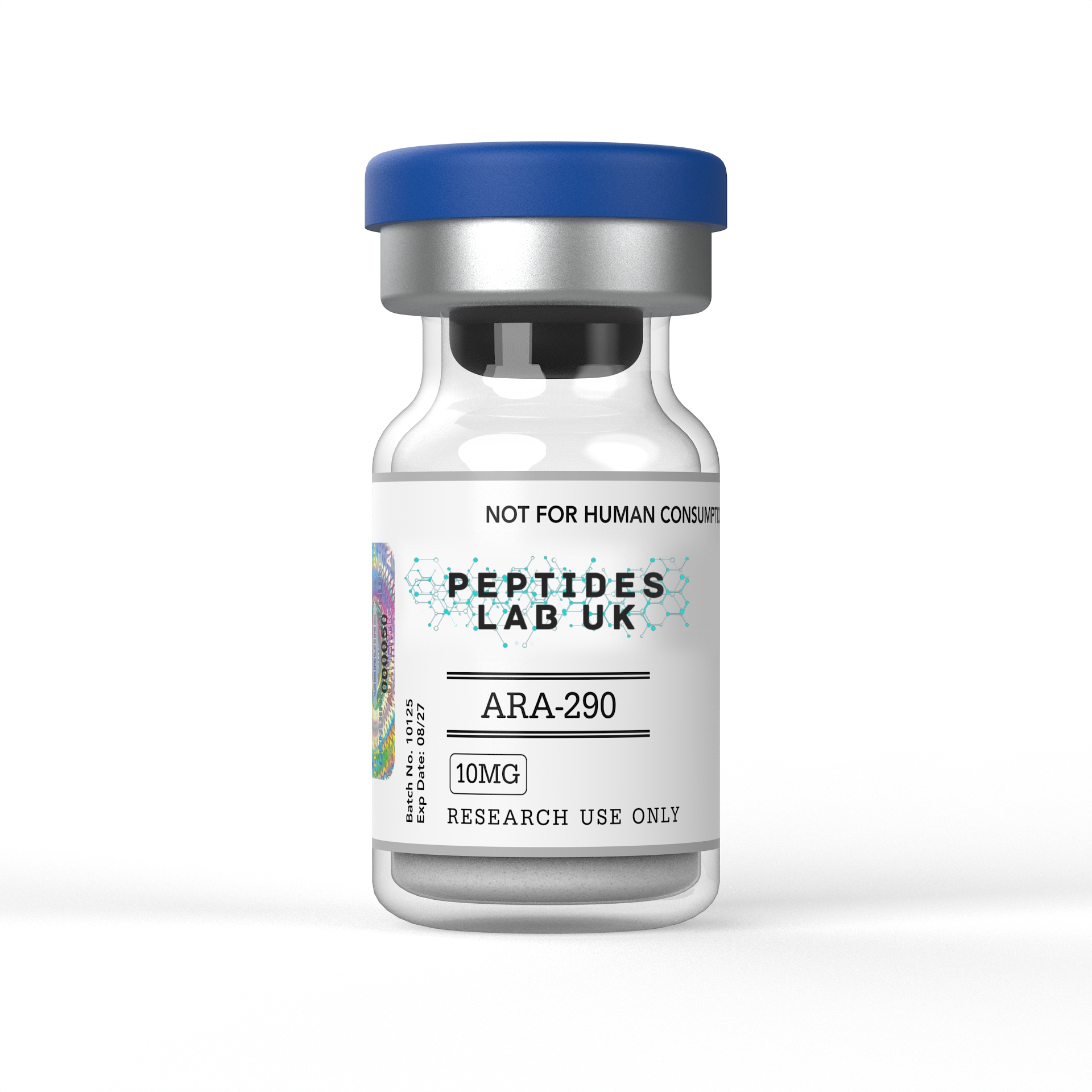
ARA-290 For Lab Research
£69.00
Login for member prices★★★★★
✔︎ Quality checked
✔︎ Third party verified
ARA-290 is a non-erythropoietic peptide from EPO’s innate repair receptor domain, used in laboratory and in vitro research. Supplied at high purity with a full COA. For laboratory and in vitro research use only. Not for human consumption. Not a medicine.

Looking for a Certificate of Analysis?
If you are looking for a Certificate Of Analysis, please email research@peptideslabuk.com to have it sent to you.
Please Note: Many sites are displaying counterfeit COAs, so ours is provided upon request.
If you are looking for a Certificate Of Analysis, please email research@peptideslabuk.com to have it sent to you.
Please Note: Many sites are displaying counterfeit COAs, so ours is provided upon request.
You may also like…
-
Login for member prices
-
Login for member prices
-
Login for member prices
- Login for member prices
-
Login for member prices

Product Description
Buy ARA-290 Peptide UK – >99% Purity | Cibinetide | Innate Repair Receptor Agonist | Research Use Only
ARA-290 (Cibinetide) is a synthetic 11-amino acid non-erythropoietic peptide derived from the tissue-protective helix B surface peptide region of erythropoietin (EPO), engineered to selectively activate the Innate Repair Receptor (IRR) — a heteromeric complex of the erythropoietin receptor (EPOR) and the β-common receptor (βCR/CD131) — studied extensively for neuroprotection, small fibre neuropathy, diabetic neuropathy, and tissue repair research. Buy ARA-290 peptide in the UK from Peptides Lab UK with >99% HPLC-verified purity, batch-specific COA, and fast UK dispatch for laboratory and in-vitro research use only.
What is ARA-290 Peptide?
ARA-290, also known as Cibinetide, is a synthetic 11-amino acid peptide derived from the helix B surface of erythropoietin — the region specifically responsible for EPO’s tissue-protective effects, entirely separate from the receptor binding domain responsible for red blood cell production.
Developed by Araim Pharmaceuticals (co-founded by Dr. Anthony Cerami and Dr. Michael Brines at The Feinstein Institute for Medical Research, Northwell Health, New York), ARA-290 was specifically engineered to dissociate erythropoietin’s two major functional activities:
- Erythropoiesis (red blood cell stimulation — driven by EPOR homodimer activation) — eliminated in ARA-290
- Tissue protection and repair (anti-inflammatory, anti-apoptotic, neuroprotective — driven by IRR activation) — selectively retained in ARA-290
This elegant dissociation is the core of ARA-290’s research significance. Full-length EPO, while potently tissue-protective, carries serious cardiovascular risks when used outside erythropoietic contexts due to increased haematocrit, thrombosis risk, and hypertension. ARA-290 provides researchers with access to EPO’s tissue-protective signalling cascade without any of these confounds — making it a uniquely tractable tool for investigating the IRR pathway in isolation.
ARA-290 holds FDA Orphan Drug Designation for the treatment of neuropathic pain in sarcoidosis, has completed positive Phase 2 clinical trials across multiple indications, and has demonstrated activity in multiple controlled clinical and pre-clinical research settings.
Product Specifications:
| Parameter | Specification |
|---|---|
| Synonyms | Cibinetide, ARA290, Helix B Surface Peptide |
| Amino Acids | 11 |
| Molecular Target | Innate Repair Receptor (IRR): EPOR/βCR heteromer |
| Purity | >99% (HPLC verified) |
| Form | Lyophilised powder |
| Storage | –20°C, protect from light and moisture |
| Solubility | Sterile water, bacteriostatic water |
| FDA Status | Orphan Drug Designation (sarcoidosis neuropathic pain) |
What is the Innate Repair Receptor (IRR)?
The Innate Repair Receptor (IRR) — also referred to as the tissue-protective receptor or β-common receptor complex — is a heteromeric receptor formed by the co-assembly of the erythropoietin receptor (EPOR) and the β-common receptor (βCR, CD131). The βCR is also shared by receptors for IL-3, IL-5, and GM-CSF, linking the IRR to broad immunomodulatory signalling networks.
The IRR is distinct from the EPOR homodimer responsible for erythropoiesis. It is upregulated in response to tissue injury, hypoxia, metabolic stress, and inflammation — acting as a damage-sensing and repair-initiating signalling complex. When activated, the IRR initiates several critical cytoprotective cascades:
- JAK2/STAT3 and STAT5 signalling — promoting anti-apoptotic gene expression and cellular survival
- PI3K/Akt pathway — suppressing pro-apoptotic factors and promoting neuronal and endothelial cell survival
- NF-κB modulation — reducing pro-inflammatory cytokine production including TNF-α, IL-1β, and IL-6
- MAPK/ERK activation — supporting cellular repair and adaptive stress responses
- Anti-oxidant pathway upregulation — reducing oxidative damage in metabolically stressed cells
ARA-290’s selective activation of the IRR — without EPOR homodimer engagement — allows researchers to study all of the above pathways without the erythropoietic confound present in full-length EPO studies.
How Does ARA-290 Work?
ARA-290 operates through three complementary mechanisms identified across pre-clinical and clinical research:
1. Innate Repair Receptor (IRR) Activation: ARA-290 binds selectively to the IRR (EPOR/βCR heteromer), activating the full IRR-mediated tissue protection cascade: JAK2/STAT3, PI3K/Akt, and MAPK/ERK signalling, producing anti-apoptotic, anti-inflammatory, and regenerative downstream effects across neural, vascular, and metabolic cell types.
2. TRPV1 Channel Inhibition: Research published in Molecular Immunology (2023) identified a second direct analgesic mechanism — ARA-290 specifically inhibits TRPV1 (Transient Receptor Potential Vanilloid 1) channel activity in peripheral nociceptors, increasing the pain threshold and relieving mechanical hypersensitivity independent of its anti-inflammatory IRR actions. This dual mechanism — central anti-inflammatory via IRR and peripheral nociceptor inhibition via TRPV1 — makes ARA-290 particularly relevant for neuropathic pain research models.
3. Small Nerve Fibre Regeneration: Multiple clinical and pre-clinical studies have confirmed that ARA-290 promotes the regeneration and increased density of small nerve fibres — specifically intraepidermal nerve fibre density (IENFD) and corneal nerve fibre density (CNFD). These small unmyelinated C-fibres and thinly myelinated Aδ-fibres are the primary fibres affected in diabetic peripheral neuropathy, sarcoidosis-associated neuropathy, and other small fibre neuropathy conditions, making their regeneration a central focus of ARA-290 research.
What Does ARA-290 Do in Research?
In pre-clinical and clinical research models, ARA-290 has demonstrated significant activity across multiple domains:
Neuropathy and Pain Research:
- Diabetic peripheral neuropathy (DPN) — Phase 2 clinical study confirmed ARA-290 significantly improved HbA1c, lipid profiles, and neuropathic symptom scores in type 2 diabetes patients over 56 days; confirmed increased small nerve fibre abundance in both skin and cornea
- Sarcoidosis-associated small fibre neuropathy — Phase 2 RCT confirmed ARA-290 produced relief of neuropathy-related symptoms in sarcoidosis patients with moderate-to-severe neuropathic pain, with approximately 50% response rate versus placebo; confirmed increased corneal nerve fibre density (CNFD); ARA-290 received FDA Orphan Drug Designation for this indication
- TRPV1-mediated pain models — ARA-290 demonstrated specific inhibition of TRPV1 channel activity, relieving capsaicin-induced mechanical hypersensitivity in pre-clinical nociceptor models
- Complex Regional Pain Syndrome (CRPS) — investigational studies have examined ARA-290 in CRPS models due to its dual anti-inflammatory and nociceptor-targeting mechanism
- Chronic neuropathic pain — multiple studies confirm ARA-290 reduces neuroinflammation in the spinal cord by suppressing TNF-α, IL-1β, and other pro-inflammatory cytokines that maintain chronic pain states
Neuroprotection and CNS Research:
- Cerebral ischaemia/stroke models — Wang et al. (2024, CNS Neuroscience & Therapeutics) confirmed ARA-290 provided neuroprotective effects in a mouse MCAO (middle cerebral artery occlusion) model comparable to full-length EPO, significantly reducing neuronal apoptosis and inflammatory cytokines, confirmed to act via βCR without stimulating erythropoiesis
- Blood-brain barrier (BBB) penetration — confirmed in pre-clinical studies; despite a short plasma half-life (~2 minutes in rodents), ARA-290 crosses the BBB and exerts central neurological effects
- Neural and cognitive processing — Cerit H et al. (2015, European Neuropsychopharmacology) investigated neural and cognitive processing changes following ARA-290 administration in human volunteers, examining its CNS modulatory properties
Metabolic and Tissue Repair Research:
- Type 2 diabetes metabolic control — Phase 2 study (Brines M et al., 2014) confirmed improvement in HbA1c and lipid profiles, with effects persisting throughout a 56-day observation period
- Pancreatic islet protection — pre-clinical research has examined ARA-290 for cytoprotection of pancreatic islet cells via EPO/IRR anti-apoptotic signalling, relevant to both T1DM and T2DM research
- Wound healing and burn models — pre-clinical studies confirmed ARA-290 promotes vascular repair and improved relative vascular area (RVA) in burn wound models via IRR-mediated angiogenic signalling
- Acute kidney injury models — confirmed beneficial effects in AKI pre-clinical models via IRR anti-apoptotic and anti-inflammatory pathways
- Pulmonary and sarcoidosis models — beyond neuropathy, ARA-290 has been studied in sarcoidosis systemic inflammation models, examining IRR’s role in multi-system inflammatory disease modulation
What Do Studies Say About ARA-290 Peptide?
ARA-290 has a well-developed body of peer-reviewed pre-clinical and clinical research literature:
- Brines M et al. (2004) — Proceedings of the National Academy of Sciences (PNAS), 101(39): 14907–14912 — Foundational study identifying the EPO/β-common receptor heteromer (IRR) as the mediator of EPO’s tissue-protective effects, distinct from the EPOR homodimer responsible for erythropoiesis. Established the scientific basis for ARA-290’s design. DOI: 10.1073/pnas.0406491101
- Brines M et al. (2014) — Molecular Medicine, 20(1): 658–666 — Phase 2 clinical study confirming ARA-290 (4 mg daily × 28 days) improved HbA1c, lipid profiles, and neuropathic symptoms in type 2 diabetes patients over 56 days. No safety issues identified. Confirmed increased small nerve fibre abundance in skin and cornea. PubMed: 25387363. DOI: 10.2119/molmed.2014.00215
- Heij L et al. (2012) — Molecular Medicine, 18: 1430–1436 — Randomised, double-blind pilot study confirming safety and efficacy of ARA-290 in sarcoidosis patients with small fibre neuropathy. Confirmed improved neuropathic symptom scores and small fibre regeneration markers. DOI: 10.2119/molmed.2012.00332
- Dahan A et al. (2013) — Molecular Medicine, 19: 334–345 — Confirmed ARA-290 improves symptoms in sarcoidosis-associated small nerve fibre loss and increases corneal nerve fibre density. FDA Orphan Drug Designation followed this study series. PMC Review: PMC5741312
- Molecular Immunology (2023) — Volume 159 — Identified and confirmed TRPV1 channel inhibition as a second, direct analgesic mechanism of ARA-290, separate from IRR-mediated anti-inflammatory activity. Confirmed ARA-290 specifically inhibits TRPV1 channel activity and relieves mechanical hypersensitivity in capsaicin-induced pain models. DOI: 10.1016/j.molimm.2023.06.001
- Wang RL et al. (2024) — CNS Neuroscience & Therapeutics, 30(3): e14676 — Confirmed ARA-290 provides neuroprotection in a mouse MCAO cerebral ischaemia model via βCR, significantly reducing neuronal apoptosis and inflammatory cytokines, equivalent to EPO neuroprotection but without erythropoietic side effects. PMC: PMC10941562. DOI: 10.1111/cns.14676
- Cerit H et al. (2015) — European Neuropsychopharmacology, 25(12): 2216–2225 — Examined neural and cognitive processing following ARA-290 administration in human volunteers, providing early evidence of ARA-290’s CNS modulatory properties and cognitive relevance. DOI: 10.1016/j.euroneuro.2015.09.005Note: All clinical citations relate to pharmaceutical research studies conducted under medical supervision in clinical trial settings. ARA-290 is not approved for therapeutic use in the UK and is supplied by Peptides Lab UK strictly for in-vitro and laboratory research use only.
What is ARA-290 Used For in Research?
Researchers purchasing ARA-290 from UK peptides suppliers like Peptides Lab UK typically investigate:
- Innate Repair Receptor (IRR) activation and signalling pathway studies (JAK2/STAT, PI3K/Akt, NF-κB, MAPK/ERK)
- Small fibre neuropathy and intraepidermal/corneal nerve fibre regeneration models
- Diabetic peripheral neuropathy (DPN) and metabolic neuropathy research
- Sarcoidosis-associated neuroinflammation and multi-system inflammatory disease models
- TRPV1 channel modulation and peripheral nociceptor pain research
- Neuroprotection in cerebral ischaemia and stroke models
- Chronic neuropathic pain and central sensitisation research
- Pancreatic islet cytoprotection and diabetes tissue repair models
- Wound healing, burn injury, and vascular repair research
- Cognitive function and CNS modulatory pathway studies
- Comparative EPO-analog research: ARA-290 vs full-length EPO vs darbepoetin
- Orphan disease research: sarcoidosis, CRPS, and rare neuropathy models
ARA-290 vs Full-Length EPO vs Darbepoetin – Research Comparison
| Feature | ARA-290 (Cibinetide) | Full-Length EPO | Darbepoetin |
|---|---|---|---|
| Receptor Target | IRR (EPOR/βCR heteromer) | EPOR homodimer + IRR | EPOR homodimer + IRR |
| Erythropoiesis | None | Yes | Yes |
| Thrombosis Risk | None identified | Yes (elevated haematocrit) | Yes |
| Neuroprotection | Confirmed (multiple models) | Confirmed but limited by side effects | Limited |
| BBB Penetration | Confirmed | Limited | Limited |
| Small Fibre Regeneration | Confirmed (clinical data) | Not confirmed | Not confirmed |
| TRPV1 Inhibition | Yes (confirmed 2023) | No | No |
| FDA Orphan Drug | Yes (sarcoidosis neuropathy) | No (this indication) | No |
| Research Utility | Selective IRR tool | Broad EPO reference compound | EPO comparator |
ARA-290’s selective IRR activation without erythropoietic activity makes it the definitive research tool for studying EPO’s tissue-protective signalling pathway in complete isolation from haematopoietic confounds.
Quality & Purity Assurance
Every batch of ARA-290 from Peptides Lab UK is:
- >99% pure — HPLC and mass spectrometry verified
- Supplied with a full Certificate of Analysis (COA) on request
- Lyophilised powder for maximum stability and long shelf life
- Manufactured under strict, controlled laboratory conditions
- Consistent batch-to-batch quality for reproducible research results
Why Buy ARA-290 from Peptides Lab UK?
When you buy ARA-290 peptide UK from Peptides Lab UK, you receive:
99% purity, HPLC and MS verified, third-party tested
- Full COA documentation per batch
- Fast same-day UK dispatch with tracked delivery
- Competitive pricing with bulk research discounts available
- Trusted by researchers across the UK and Europe
Research Disclaimer: All products supplied by Peptides Lab UK are intended strictly for in-vitro laboratory research and scientific study use only. They are not intended for human consumption, veterinary use, or any medical or therapeutic application. ARA-290 (Cibinetide) holds FDA Orphan Drug Designation for sarcoidosis-associated neuropathic pain but has not received marketing authorisation or clinical approval from the MHRA, FDA, EMA, or any regulatory authority for routine therapeutic use. All clinical citations on this page relate to pharmaceutical development research conducted under medical supervision and do not constitute a claim of safety or therapeutic efficacy for the research compound as supplied. Peptides Lab UK accepts no liability for any misuse of research compounds. By purchasing, you confirm that you are a qualified researcher and that the product will be used solely within a controlled laboratory environment in compliance with all applicable UK laws, regulations, and institutional guidelines.
Related products
-
Login for member prices
-
Login for member prices
-
Login for member prices
