




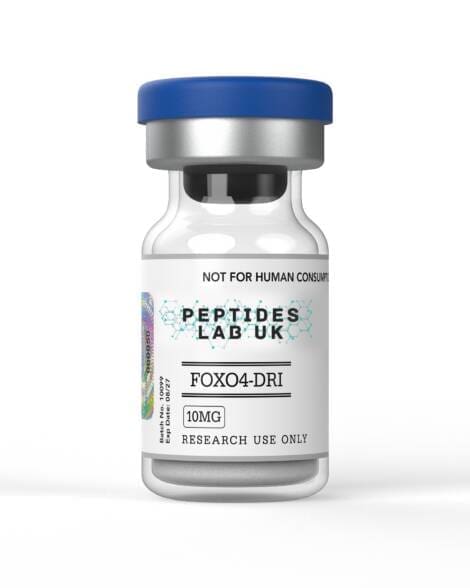


FOXO4-DRI For Lab Research
£194.99
Login for member prices★★★★★
✔︎ Quality checked
✔︎ Third party verified
FOXO4-DRI is a D-retro-inverso senolytic peptide for laboratory and in vitro research into apoptosis of senescent cells. Supplied at high purity with a full COA. For laboratory and in vitro research use only. Not for human consumption. Not a medicine.

Looking for a Certificate of Analysis?
If you are looking for a Certificate Of Analysis, please email research@peptideslabuk.com to have it sent to you.
Please Note: Many sites are displaying counterfeit COAs, so ours is provided upon request.
If you are looking for a Certificate Of Analysis, please email research@peptideslabuk.com to have it sent to you.
Please Note: Many sites are displaying counterfeit COAs, so ours is provided upon request.
You may also like…
-
Login for member prices
-
Login for member prices

Product Description
FOXO4-DRI – Selective Senolytic Research Peptide | Peptides Lab UK
FOXO4-DRI (Forkhead Box O4 D-Retro-Inverso peptide) is a cell-penetrating senolytic research peptide designed to selectively induce apoptosis in senescent cells by disrupting the FOXO4–p53 protein interaction — releasing p53 from nuclear retention and directing it to mitochondria to trigger cell-intrinsic apoptosis selectively in senescent cells while leaving non-senescent cells unaffected — supplied by Peptides Lab UK in lyophilised format at >99% purity (HPLC verified) for in vitro and pre-clinical laboratory research use only.
Available to buy in the UK from Peptides Lab UK, FOXO4-DRI is one of the most extensively studied senolytic research peptides in cellular senescence biology, with a rapidly growing published literature base spanning senescent fibroblast elimination, vascular ageing, Leydig cell senescence, chondrocyte biology, keloid scar research, cancer cell senescence, and structural NMR characterisation of the FOXO4–p53 interaction. Each batch is independently quality-tested and distributed in a controlled lyophilised format, suitable for precise laboratory handling and in vitro research protocols.
What is FOXO4-DRI?
FOXO4-DRI is a D-Retro-Inverso (DRI) isoform peptide — a synthetic peptide in which the amino acid sequence of the FOXO4 p53-binding domain has been reversed and all L-amino acids substituted with their D-amino acid counterparts. This D-retro-inverso configuration preserves the three-dimensional side-chain topology of the original FOXO4 sequence — maintaining functional mimicry of the FOXO4 forkhead domain’s interaction surface with p53 — while conferring exceptional proteolytic stability compared to the native L-amino acid sequence. This stability is critical for cell-based and in vivo research applications, where native peptides are rapidly degraded by intracellular proteases.
The biological target of FOXO4-DRI is the FOXO4–p53 protein-protein interaction — a molecular axis identified as pivotal for maintaining the viability of senescent cells. Under normal conditions in senescent cells, FOXO4 interacts with p53 and retains it in the nucleus, preventing p53 from translocating to mitochondria and executing its intrinsic pro-apoptotic programme. This FOXO4-mediated nuclear retention of p53 is a key mechanism by which senescent cells maintain apoptosis resistance despite their dysfunctional state. FOXO4-DRI acts as a competitive inhibitor of this interaction — binding directly to the transactivation domain 2 (TAD2) of p53, displacing FOXO4, and allowing phosphorylated p53 to be exported from the nucleus and directed to mitochondria, where it activates BAX, triggers caspase-3 cleavage (via the p53/BCL-2/Caspase-3 signalling pathway), and drives cell-intrinsic apoptosis.
The selectivity of FOXO4-DRI for senescent over non-senescent cells is mechanistically grounded: FOXO4 is expressed at low levels in most non-senescent adult cells, but is strongly upregulated in senescent cells. Because FOXO4-DRI’s mechanism depends on disrupting the FOXO4–p53 interaction, and because this interaction is only operative in cells with elevated FOXO4 expression, the compound preferentially targets the senescent cell population — leaving FOXO4-low non-senescent cells largely unaffected. This selectivity profile is what distinguishes FOXO4-DRI from broader cytotoxic agents and makes it the primary peptide tool for selective senescent cell elimination in the cellular senescence research field.
FOXO4-DRI – Key Research Facts
- Full name: FOXO4 D-Retro-Inverso peptide (FOXO4-DRI)
- Classification: Cell-penetrating senolytic peptide — FOXO4/p53 protein-protein interaction inhibitor
- Design: D-retro-inverso isoform of FOXO4’s p53-binding domain — reversed sequence with all D-amino acids
- Binding target: p53 transactivation domain 2 (TAD2) — displaces FOXO4 from the FOXO4-p53 complex
- Mechanism: FOXO4-DRI binds p53 TAD2 → p53 nuclear exclusion → p53 mitochondrial translocation → BAX activation → caspase-3 cleavage → senescent cell-selective apoptosis
- Selectivity basis: FOXO4 is upregulated in senescent cells but expressed at low levels in most non-senescent adult cells — selectivity is mechanistically conferred
- D-amino acid advantage: Proteolytic stability — resistant to intracellular peptidases that would rapidly degrade equivalent L-amino acid sequences
- Structural characterisation: NMR structural models of FOXO4-DRI/p53TAD2 complex resolved (Nature Communications, 2025) — confirms disordered-to-ordered transition upon binding
- Research cell types studied: IMR90 fibroblasts, TM3 Leydig cells, endothelial cells, chondrocytes, keloid fibroblasts, HCT116 cancer cells
- In vitro working concentration: 25 µM used in multiple published studies for senescent cell apoptosis induction
What Does FOXO4-DRI Do in Research?
In laboratory and pre-clinical research settings, FOXO4-DRI is used as the primary peptide tool for selective senescent cell elimination — a strategy known as senolysis. Its cell-penetrating properties allow it to enter cells without transfection or vector delivery, where it directly engages the p53 TAD2 domain to disrupt the FOXO4-p53 complex. The result is selective apoptosis of FOXO4-high senescent cells, leaving FOXO4-low non-senescent cells intact — a selectivity that makes it a uniquely powerful molecular probe for studying the contribution of senescent cell accumulation to tissue dysfunction, ageing phenotypes, and disease biology.
At the molecular level, the mechanism has been structurally resolved by NMR spectroscopy (Nature Communications, 2025): FOXO4-DRI binds to the disordered p53 TAD2 domain and forms a transiently folded complex through both the FOXO4-derived peptide region and its cationic cell permeability element. P53 phosphorylation at Ser15 enhances the affinity of both FOXO4 and FOXO4-DRI for p53 TAD2 — explaining the preferential engagement of FOXO4-DRI with the hyperphosphorylated p53 characteristic of senescent cells. Following FOXO4 displacement, the released p53 undergoes nuclear export and mitochondrial translocation, activating the intrinsic apoptosis pathway via BAX upregulation and BCL-2 downregulation, culminating in caspase-3 cleavage and apoptotic cell death.
Published pre-clinical studies have used FOXO4-DRI to demonstrate that selective elimination of senescent cells in aged mouse models can improve a range of tissue function parameters — including fitness, fur density, renal function, and liver function — establishing the broader research principle that senescent cell burden contributes meaningfully to ageing tissue dysfunction and that its targeted reduction produces measurable functional benefits in experimental models. This foundational in vivo evidence has driven an expanding research programme using FOXO4-DRI as a molecular tool across multiple tissues and disease contexts.
Key Research Areas for FOXO4-DRI
- FOXO4–p53 protein-protein interaction disruption assays — co-immunoprecipitation (CO-IP) and competitive binding studies
- Senescent cell identification and selective elimination assays — SA-β-galactosidase, p16, p21, p53 staining combined with FOXO4-DRI apoptosis induction
- p53 TAD2 binding, nuclear exclusion, and mitochondrial translocation studies — phospho-p53 (Ser15) pathway research
- BAX/BCL-2/Caspase-3 intrinsic apoptosis pathway investigations in senescent cell models
- SASP (Senescence-Associated Secretory Phenotype) characterisation and suppression — IL-6, IL-8, MMP, VEGF, CXCL2/3 pathway studies
- Tissue-specific senescent cell biology — fibroblasts, endothelial cells, Leydig cells, chondrocytes, epithelial cells
- Vascular ageing pathway research — endothelial cell senescence, aortic function, and ROS/oxidative stress studies
- Senescent Leydig cell and male reproductive ageing models — FOXO4 nuclear translocation and testosterone synthesis pathway research
- Chondrocyte senescence and cartilage biology — senescent cell removal and chondrogenic potential restoration studies
- Keloid and pathological scar biology — senescent fibroblast elimination and SASP suppression in fibrotic tissue models
- Senescent cancer cell elimination — FOXO4-DRI as a senolytic tool in oncology research models
- Comparative senolytic research — FOXO4-DRI vs. Dasatinib+Quercetin, ABT-263, and other senolytic compound classes
- Structural biology — FOXO4-DRI/p53TAD2 complex characterisation, disordered protein binding, and rational analogue design
What Do Studies Say About FOXO4-DRI?
FOXO4-DRI has a rapidly expanding and high-impact published research base, with studies published across Nature, Nature Communications, Communications Biology, Aging, Frontiers in Bioengineering and Biotechnology, and PMC since its foundational description in 2017.
Foundational Discovery — Selective Senolytic Elimination in Aged Mice (Cell, 2017 — Baar et al.)
FOXO4-DRI Restores Fitness, Fur Density, Renal and Liver Function in Aged Mice
The foundational study introducing FOXO4-DRI as a senolytic peptide was published in Cell by Baar and colleagues in 2017. The study established that FOXO4 maintains senescent cell viability by targeting p53 to the nucleus and preventing apoptosis, and that disrupting the FOXO4-p53 interaction with FOXO4-DRI causes p53 nuclear exclusion and cell-intrinsic apoptosis in ionising radiation-induced and doxorubicin-induced senescent IMR90 fibroblasts. Critically, FOXO4-DRI treatment had no measurable effect on cell viability of non-senescent cells. In naturally aged mice and in doxorubicin-treated mice, FOXO4-DRI treatment significantly improved physical fitness, restored fur density, improved renal function, and improved liver function — effects attributed to the selective elimination of accumulated senescent cells. The authors established FOXO4-DRI as a first-in-class senolytic peptide tool for cellular senescence research, with mechanistic selectivity grounded in the elevated FOXO4-p53 interaction in senescent versus non-senescent cells.
Reference: Baar MP et al. (2017). Targeted Apoptosis of Senescent Cells Restores Tissue Homeostasis in Response to Chemotoxicity and Aging. Cell. DOI: 10.1016/j.cell.2017.02.031. PubMed PMID: 28340339.
NMR Structural Resolution of FOXO4-DRI/p53TAD2 Complex (Nature Communications, 2025)
Disordered-to-Ordered Complex Formation: Structural Basis of FOXO4-DRI’s Senolytic Mechanism
A landmark structural study published in Nature Communications (2025) resolved the solution NMR structural models of the p53 transactivation domain (TAD2) in complex with the FOXO4 forkhead domain and with FOXO4-DRI. The study confirmed that FOXO4-DRI binds directly to the disordered p53 TAD2 domain and forms a transiently folded complex — a disordered-to-ordered transition involving both the FOXO4-derived region of the DRI peptide and its cationic cell permeability element. P53 phosphorylation at Ser15 was confirmed to enhance the affinity for both FOXO4 and FOXO4-DRI, providing a structural explanation for FOXO4-DRI’s preferential engagement with the hyperphosphorylated p53 that characterises senescent cells. The authors described these structural models as the basis for rational development of p53 inhibitors targeting the senescent cell biology field and diseases linked to cellular senescence including cancer.
Reference: Kong et al. / Bourgeois et al. (2025). The disordered p53 transactivation domain is the target of FOXO4 and the senolytic compound FOXO4-DRI. Nature Communications. DOI: 10.1038/s41467-025-60844-9.
Senescent Leydig Cell Elimination & Testosterone Restoration in Aged Mice (Aging / PMC, 2020)
FOXO4-DRI Disrupts FOXO4-p53 in Senescent Leydig Cells and Improves Testicular Microenvironment
A study published in Aging (and indexed on PMC) demonstrated that FOXO4 is specifically expressed in human Leydig cells, with nuclear translocation of FOXO4 in elderly men correlating with decreased testosterone synthesis. Using hydrogen peroxide-induced senescent TM3 Leydig cells as an in vitro model, the study confirmed that FOXO4 maintains senescent Leydig cell viability and suppresses apoptosis. FOXO4-DRI at 25 mM concentration selectively induced p53 nuclear exclusion and apoptosis in the senescent Leydig cells, confirmed by Annexin V-FITC/PI apoptosis assays and immunofluorescent staining of Ser15-phospho-p53 foci. In naturally aged mice, FOXO4-DRI improved the testicular microenvironment and alleviated age-related testosterone secretion insufficiency — with decreased p53, p21, and p16 protein levels in treated testes compared to aged controls.
Reference: Zhang C et al. (2020). FOXO4-DRI alleviates age-related testosterone secretion insufficiency by targeting senescent Leydig cells in aged mice. Aging. DOI: 10.18632/aging.102682. PubMed PMID: 31959736.
Senescent Endothelial Cell Elimination & Vascular Ageing (Frontiers in Bioengineering, 2025/2026)
p53/BCL-2/Caspase-3 Pathway Activation Selectively Clears Senescent Endothelial Cells
A study published in Frontiers in Bioengineering and Biotechnology investigated the mechanism by which FOXO4-DRI induces apoptosis in senescent endothelial cells. Using co-immunoprecipitation (CO-IP), the study confirmed that FOXO4-DRI prevents FOXO4 binding to p53, facilitating phosphorylated p53 nuclear exclusion, which triggers BAX upregulation and cleaved caspase-3 activation — driving selective apoptosis of senescent endothelial cells. Injection of FOXO4-DRI in both naturally aged and D-galactose-induced ageing mice effectively suppressed aortic ageing markers and improved aortic function. FOXO4-DRI also alleviated endothelial senescence induced by oxygen-glucose deprivation (OGD) in vitro, enhancing endothelial cell function. The study was described as the first to demonstrate that FOXO4-DRI activates the p53/BCL-2/Caspase-3 pathway specifically in senescent endothelial cells.
Reference: FOXO4-DRI regulates endothelial cell senescence via the P53 signaling pathway. Frontiers in Bioengineering and Biotechnology. PubMed PMID: 41625068.
Senescent Chondrocyte Removal & Chondrogenic Potential Restoration (PMC, 2021)
FOXO4-DRI Removes Replication-Stress Senescent Chondrocytes in ACI Research Model
A study published in PMC investigated FOXO4-DRI in the context of autologous chondrocyte implantation (ACI) — a procedure in which in vitro chondrocyte expansion generates a senescent cell burden that adversely affects cartilage formation quality and quantity. Chondrocytes expanded to population doubling level 9 (PDL9) were treated with FOXO4-DRI to remove accumulated senescent cells. FOXO4-DRI successfully removed senescent chondrocytes, and the results confirmed that removal of senescent cells significantly increased cartilage formation potential and reduced degenerative enzyme production. The study confirmed FOXO4-DRI was effective across senescent cells generated by different methods (irradiation, doxorubicin, and replication stress), and documented that pre-treatment with FOXO4-DRI attenuated the dedifferentiation of chondrocytes during in vitro expansion — establishing it as a valuable tool for research into senescent cell biology in cartilage and musculoskeletal models.
Reference: Senolytic Peptide FOXO4-DRI Selectively Removes Senescent Cells From in vitro Expanded Human Chondrocytes (2021). PMC Article PMC8116695.
Keloid Senescent Fibroblast Elimination & SASP Suppression (Communications Biology, 2025)
FOXO4-DRI Induces p53-pS15 Nuclear Exclusion and Apoptosis in Keloid Fibroblast Models
A study published in Communications Biology (Nature Publishing Group, 2025) used single-cell RNA sequencing to characterise the senescent cell landscape in keloids — pathological scars with tumour-like aggressiveness. The study identified increased proportions of pro-inflammatory and mesenchymal fibroblast subpopulations, elevated p16 protein and SA-β-galactosidase-positive cells, and enhanced SASP gene expression in keloid tissue. Upregulated p53-Ser15 phosphorylation (p53-pS15) was identified as a key marker. Treatment with FOXO4-DRI at 25 µM in serum-limited senescent fibroblast and keloid organ culture models promoted apoptosis, decreased G0/G1 phase cells, and induced p53-pS15 nuclear exclusion — confirmed by Annexin V-FITC/PI apoptosis assays and TUNEL staining of keloid organ cultures at days 3, 7, and 10. The authors concluded that the senescent microenvironment maintained by SASP and p53-pS15 signalling promotes keloid aggressiveness and relapse, and that FOXO4-DRI targets this mechanism selectively.
Reference: FOXO4-DRI induces keloid senescent fibroblast apoptosis by promoting nuclear exclusion of upregulated p53-serine 15 phosphorylation. Communications Biology. DOI: 10.1038/s42003-025-07738-0. PubMed PMID: 39994346.
FOXO4-DRI UK – Specifications
Product Details
- Full name: FOXO4 D-Retro-Inverso peptide (FOXO4-DRI)
- Classification: Cell-penetrating senolytic peptide — FOXO4/p53 PPI inhibitor
- Purity:>99% (HPLC verified)
- Form: Lyophilised powder
- Storage: Store dry at –20°C; protect from light
- Solubility: Sterile water, bacteriostatic water, PBS, or suitable laboratory buffer
- In vitro working concentration: 25 µM used in multiple published studies
- Distributed by: Peptides Lab UK
- Quality assurance: Rigorous batch-level analysis; certificate of analysis available on request
Research Applications
Suitable Laboratory Uses for FOXO4-DRI
- FOXO4-p53 protein-protein interaction disruption assays — CO-IP, competitive binding, and proximity ligation studies
- Selective senescent cell apoptosis induction — SA-β-gal, p16, p21, p53 marker-confirmed senescent populations
- p53 TAD2 binding, phospho-p53 (Ser15) nuclear exclusion, and mitochondrial translocation pathway studies
- BAX/BCL-2/Caspase-3 intrinsic apoptosis cascade investigations in senescent cell models
- SASP characterisation and suppression — IL-6, IL-8, MMP, VEGF, CXCL2/3 secretome studies
- Tissue-specific senescence models — fibroblasts, endothelial cells, Leydig cells, chondrocytes, keloid fibroblasts
- Vascular ageing pathway research — endothelial senescence, aortic function, and ROS pathway studies
- Senescent cancer cell biology and drug resistance pathway research
- Comparative senolytic research — FOXO4-DRI vs. Dasatinib+Quercetin, ABT-263, and navitoclax
- Structural biology — disordered protein-protein interaction studies, DRI peptide design, and p53 inhibitor development
- Molecular analysis and controlled laboratory experiments
Why Buy FOXO4-DRI in the UK from Peptides Lab UK?
Peptides Lab UK is a trusted UK-based supplier of research-grade peptides. All products are distributed in lyophilised format with batch-verified purity documentation. Whether you are looking to buy FOXO4-DRI in the UK, sourcing a verified senolytic research peptide for cellular senescence studies, or searching for a reliable UK peptides supplier with documented quality control, Peptides Lab UK provides consistent quality with rigorous third-party analysis on every batch.
FOXO4-DRI’s D-retro-inverso configuration provides exceptional proteolytic stability compared to equivalent L-amino acid senolytic peptides — a critical property for cell-based and pre-clinical research where intracellular peptidase activity would rapidly degrade unstable L-amino acid sequences. The >99% HPLC-verified purity standard applied to Peptides Lab UK’s FOXO4-DRI preparation ensures that selectivity measurements, apoptosis assay results, and FOXO4-p53 disruption data reflect authentic FOXO4-DRI pharmacology.
Related Search Terms
Researchers searching for: buy FOXO4-DRI UK, FOXO4-DRI peptide UK, senolytic peptide UK, FOXO4-DRI for sale UK, FOXO4 DRI research UK, buy senolytic UK, cellular senescence research peptide UK, UK peptides research grade, Peptides UK lab supply, FOXO4-DRI in the UK, p53 senolytic peptide UK, senescent cell apoptosis research UK, buy FOXO4-DRI research peptide UK, ageing research peptide UK, FOXO4 p53 inhibitor UK — Peptides Lab UK supplies this compound for qualified laboratory researchers within the United Kingdom.
Important Notice & Research Disclaimer
⚠️ This product is supplied by Peptides Lab UK strictly for laboratory research use only. FOXO4-DRI as distributed by Peptides Lab UK is not intended for, and must not be used for, human consumption, medical treatment, self-administration, veterinary applications, or any use outside of a controlled laboratory environment. This compound is handled exclusively in controlled research settings for in vitro and pre-clinical studies, with no applications in human or veterinary medicine.
Handling must only be performed by qualified and trained laboratory professionals in accordance with applicable regulations and institutional guidelines. Peptides Lab UK accepts no liability for any use of this compound outside of its intended laboratory research purpose.
References to published research throughout this description are provided for informational and research context only and do not constitute medical claims or endorsements of any therapeutic application of this product.
Related products
-
Login for member prices
-
Login for member prices
-
Login for member prices
