




No products in the cart.

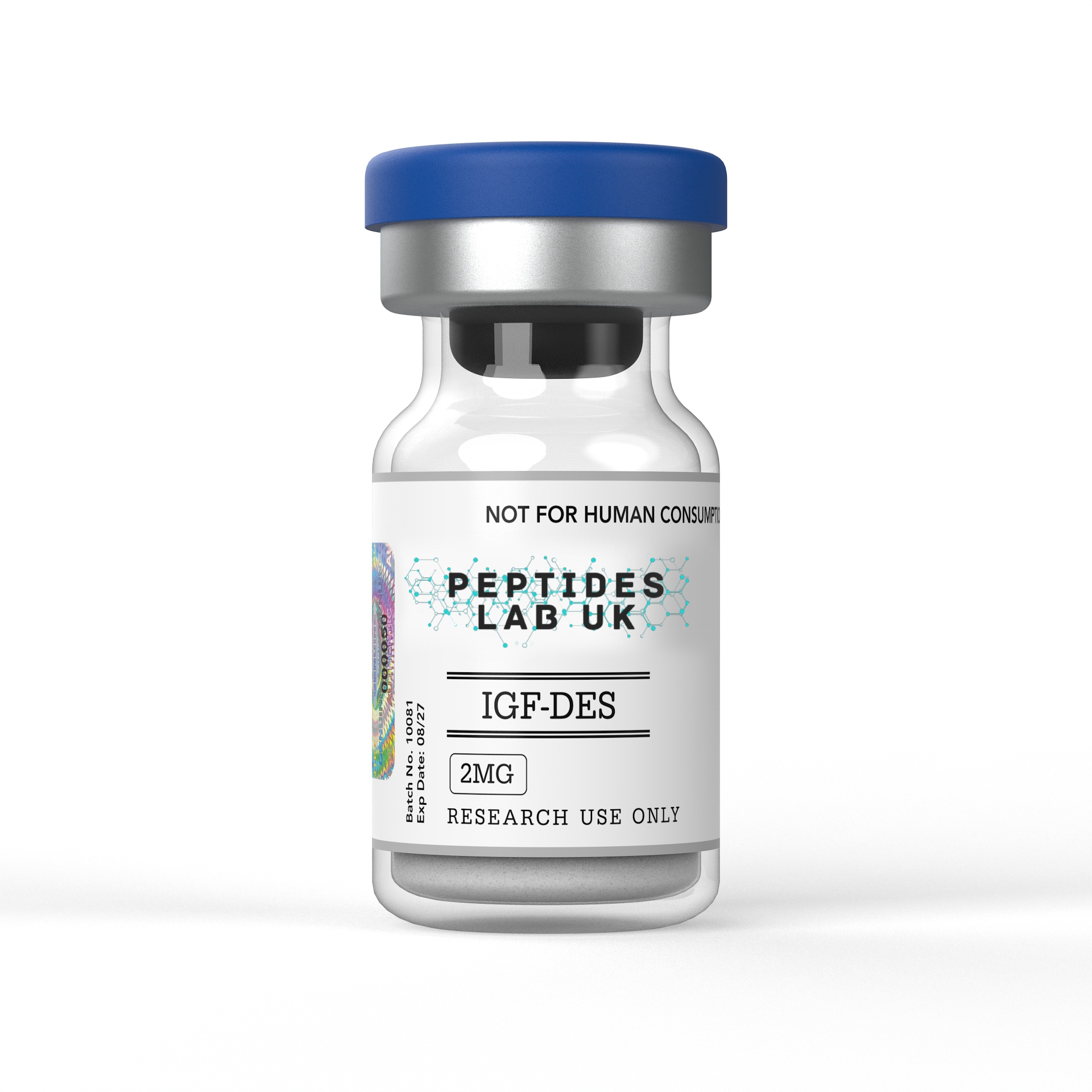
IGF-DES For Lab Research
£51.99
Login for member prices★★★★★
✔︎ Quality checked
✔︎ Third party verified
IGF-DES (des(1-3)IGF-1) is a truncated, high-potency form of IGF-1 for laboratory and in vitro research. Supplied at >99% purity with a full COA. For laboratory and in vitro research use only. Not for human consumption. Not a medicine.

Looking for a Certificate of Analysis?
If you are looking for a Certificate Of Analysis, please email research@peptideslabuk.com to have it sent to you.
Please Note: Many sites are displaying counterfeit COAs, so ours is provided upon request.
If you are looking for a Certificate Of Analysis, please email research@peptideslabuk.com to have it sent to you.
Please Note: Many sites are displaying counterfeit COAs, so ours is provided upon request.
You may also like…
-
Login for member prices

-
Login for member prices
Product Description
IGF-DES Peptide | Buy IGF-1 DES UK | Truncated IGF-1 Analogue | Research Use Only
IGF-DES (Des(1–3)IGF-1) is a naturally occurring, endogenous truncated analogue of Insulin-like Growth Factor-1 (IGF-1), lacking the first three N-terminal amino acids of the native sequence. It is studied extensively in laboratory research for its markedly reduced binding to IGF-binding proteins (IGFBPs), enhanced IGF-1 receptor potency, and highly localised tissue-level signalling activity — available to buy in the UK from Peptides Lab UK in high-purity lyophilised form, >99% HPLC-verified purity, with batch-specific COA and fast UK dispatch for laboratory and in vitro research use only.
Distributed by Peptides Lab UK in a high-purity lyophilised format, for laboratory research use only. This compound is handled in controlled settings for in vitro and pre-clinical studies, with no applications in human or veterinary medicine. Each batch undergoes rigorous quality analysis to ensure >99% purity (HPLC verified).
What Is IGF-DES?
Des(1–3)IGF-1 is a naturally occurring, endogenous truncated analogue of Insulin-like Growth Factor-1 (IGF-1), lacking the first three amino acids at the N-terminus of IGF-1, giving it a total of 67 amino acids compared to the 70 of native IGF-1.
This structural difference — the removal of the Gly-Pro-Glu tripeptide — has a profound effect on pharmacological behaviour. As a result of this difference, IGF-DES has considerably reduced binding to the insulin-like growth factor-binding proteins (IGFBPs) and enhanced potency of approximately 10-fold in vivo relative to IGF-1.
In circulation, the vast majority of IGF-1 exists bound to one of the IGFBPs, with IGFBP-3 accounting for approximately 80% of all binding. The half-lives of unbound IGF-1, IGF-1 in a binary complex, and IGF-1 in a ternary complex are less than 10 minutes, 25 minutes, and more than 16 hours respectively — meaning that IGF-1 activity is tightly regulated by its binding proteins. By evading this sequestration, IGF-DES is able to engage the IGF-1 receptor (IGF-1R) more directly, making it a uniquely valuable research tool for studying IGFBP-independent IGF-1 receptor signalling.
As a research compound, IGF-1 DES UK carries one of the most clearly characterised structural modification profiles of any IGF-1 analogue, with published research spanning receptor binding, myogenic cell biology, IGFBP regulation, and tissue repair pathway modelling.
How Does IGF-DES Work?
IGF-DES functions through direct activation of the IGF-1 receptor (IGF-1R) tyrosine kinase, bypassing the IGFBP regulatory system that normally sequesters the majority of circulating native IGF-1.
IGFBP Evasion and Enhanced Receptor Availability
The biological potency of des-(1-3)-IGF-1 correlates inversely with its binding to proteins released into the medium by cells, so that its enhanced potency is a consequence of it not binding to purified binding proteins or those released by cultured cells. This mechanism — IGFBP evasion rather than inherently higher receptor affinity — is now the accepted explanation for IGF-DES’s superior in vitro and in vivo potency relative to native IGF-1.
IGF-1R Receptor Binding and Downstream Signalling
Both IGF-1 and des-(1-3)IGF-1 bind only to the type 1 IGF receptor in L6 myoblasts, rat vascular smooth-muscle cells, and human lung fibroblasts, with binding potencies in the order des-(1-3)IGF-1 greater than IGF-1 — a difference attributed to the lower affinity of des-(1-3)IGF-1 for the competing IGFBP rather than superior intrinsic receptor affinity.
PI3K/Akt/mTOR and MAPK Pathway Activation
IGF-1R engagement activates two primary downstream signalling pathways: the PI3K/Akt/mTOR pathway, primarily responsible for protein synthesis, cell growth, and inhibition of protein breakdown; and the MAPK/ERK pathway, involved in cell proliferation and differentiation. IGF-DES activates these same pathways via IGF-1R but without the prior IGFBP buffering that attenuates native IGF-1 signalling.
Localised Autocrine/Paracrine Activity
IGF-DES produces rapid and localised IGF-1R activation with a shorter activity period. Its strong local receptor affinity makes it particularly useful for studying tissue-specific IGF-1 effects and acute signalling responses.
What Does IGF-DES Do in Research?
In laboratory settings, IGF-DES has been studied across several key biological systems. Research has examined its role in:
- IGFBP-independent IGF-1R binding and receptor activation studies
- Myogenic cell proliferation, satellite cell activation, and muscle biology research
- PI3K/Akt/mTOR and MAPK pathway signalling investigations
- IGFBP-3 regulation and gene expression modelling in muscle cell cultures
- Tissue repair and wound healing pathway research
- Comparative IGF-1 analogue studies alongside IGF-1 LR3 and native IGF-1
- Neuroregeneration and CNS biology research models
- Cell differentiation and anti-apoptotic pathway studies
IGF-DES and Myogenic Cell Research
Treatment of porcine embryonic myogenic cells with Des(1-3)IGF-1 resulted in a threefold reduction in IGFBP-3 levels in conditioned media, while IGF-1 treatment caused a fourfold increase in the steady-state level of myogenin mRNA — suggesting that IGF-I treatment accelerates differentiation of myogenic cells, and that this differentiation may be preceded or accompanied by decreased IGFBP-3 production.
IGF-DES and Skeletal Muscle Hypertrophy Research
IGF-1 signalling via the PI3K/Akt pathway drives protein synthesis through activation of ribosomal protein S6 and the translation initiation factor eIF4E downstream of mTORC1, and can suppress protein degradation via inhibition of FoxO-mediated transcription of E3 ubiquitin ligases — mechanisms that are directly relevant to muscle hypertrophy and atrophy research models in which IGF-DES is employed as a research tool.
IGF-DES and IGFBP Biology Research
Research using radiolabelled des(1-3)IGF-1 as a probe confirmed that IGFBP-3 is as potent as unlabelled IGF-1 in displacing it from cell surface binding — providing evidence that IGFBP-3 can modulate IGF-1R access via a cellular mechanism distinct from simple extracellular sequestration, a key finding in IGFBP-IGF-1R interaction research.
IGF-DES and the IGF-1R Signalling Network
The IGF-1R is a cell-surface protein evolutionarily related to the insulin receptor, and its biological actions are moderated by IGFBPs that bind and transport the ligand in circulation. IGF-1R function is linked to the MAPK and PI3K signalling pathways, and IGF-1R has also been found to migrate to the cell nucleus where it functions as a transcriptional activator. IGF-DES, by reducing IGFBP interference, allows researchers to study these pathways with reduced regulatory confounds.
What Do Studies Say About IGF-DES?
IGF-DES has been characterised in peer-reviewed research since the late 1980s, with studies spanning receptor binding, cell biology, tissue repair, and IGFBP interaction.
IGF-DES Potency vs Native IGF-1
Studies using cultured cells confirmed that the biological potencies of IGF-1, IGF-2, and des-(1-3)-IGF-1 correlate inversely with their binding to IGFBP proteins in conditioned media — establishing that des-(1-3)-IGF-1’s enhanced in vivo and in vitro potency is a direct consequence of reduced IGFBP sequestration rather than greater intrinsic receptor affinity.
IGF-DES Receptor Binding Specificity
Competitive binding and receptor cross-linking experiments confirmed that both IGF-1 and des-(1-3)IGF-1 bind exclusively to the type 1 IGF receptor in L6 myoblasts, rat vascular smooth-muscle cells, and human lung fibroblasts — with des-(1-3)IGF-1 demonstrating greater apparent potency in these assays, attributable to its low affinity for the competing 38 kDa IGFBP rather than differences in intrinsic receptor affinity.
IGF-DES and Cardiovascular Biology Research
IGF-1 signalling — mediated by the same IGF-1R that IGF-DES engages — regulates cell division, proliferation, and survival, with ERK/MAPK and PI3K/Akt representing the main pathways involved in IGF-1 signal transduction. Activation of these pathways confers multiple effects on the cardiovascular system studied in pre-clinical models.
Key cited studies:
- Ballard FJ et al. (1987) — Natural and Synthetic Forms of IGF-1 and the Potent Derivative, Destripeptide IGF-1: Biological Activities and Receptor Binding — Biochem Biophys Res Commun. PubMed ID: 3122706
- Ballard FJ et al. (1988) — Specific Binding of IGFs 1 and 2 to the Type 1 and Type 2 Receptors — Biochem J 249(3):721–726. PubMed ID: 2965574
- Oh Y et al. (1993) — Insulin-like Growth Factor (IGF) Binding Proteins Inhibit the Biological Activities of IGF-1 and IGF-2 but Not des-(1–3)-IGF-1 — PMC1138350
- Clemmons D et al. (1997) — IGFBP-3 Interacts with the Type 1 IGF Receptor, Reducing Receptor Affinity — PubMed ID: 9389554
- Coleman ME et al. (1999) — Effect of IGF-I and Des(1-3)IGF-I on IGFBP-3 Levels in Porcine Embryonic Muscle Cells — PubMed ID: 10048587
IGF-DES vs Other IGF-1 Research Analogues
| Feature | IGF-DES | IGF-1 LR3 | Native IGF-1 |
|---|---|---|---|
| Sequence | 67 aa (N-terminal truncated) | 83 aa (extended + Arg3 substitution) | 70 aa (full sequence) |
| IGFBP Binding | Very low | Low | High (~98% bound) |
| Receptor Potency | ~10x native IGF-1 (in vivo) | ~2–3x native IGF-1 | Reference |
| Half-Life | ~20–30 minutes | ~20–30 hours | <10 min (free) |
| Activity Profile | Rapid, localised | Prolonged, systemic | Short, systemic |
| Primary Research Use | Localised tissue, receptor binding | Systemic GH axis modelling | IGF-1 baseline reference |
IGF-DES’s combination of IGFBP evasion, rapid localised receptor activation, and well-characterised structural modification makes it the preferred IGF-1 analogue in research contexts requiring IGFBP-independent signalling study or localised tissue pathway investigation.
Quality & Purity Assurance
Every batch of IGF-DES from Peptides Lab UK is:
- >99% pure — HPLC and mass spectrometry verified
- Supplied with a full Certificate of Analysis (COA) on request
- Lyophilised powder for maximum stability and long shelf life
- Manufactured under strict, controlled laboratory conditions
- Consistent batch-to-batch quality for reproducible research results
Buy IGF-DES UK — Product Specifications
| Property | Detail |
|---|---|
| Sequence | TLCGAELVDALQFVCGDRGFYFNKPTGYGSSSRRAPQTGIVDECCFRSCDLRRLEMYCAPLKPAKSA |
| Molecular Weight | 7,365.42 g/mol |
| Molecular Formula | C₃₁₉H₄₉₅N₉₁O₉₆S₇ |
| Purity | >99% (HPLC verified) |
| Form | Lyophilised powder |
| Storage | Store dry at -20°C; protect from light |
| Solubility | Bacteriostatic water, sterile water, or suitable laboratory solvents |
IGF-DES Research Applications
IGF-DES peptide UK is supplied strictly for the following in vitro and pre-clinical research uses:
- IGFBP-independent IGF-1R receptor binding and activation studies
- PI3K/Akt/mTOR and MAPK downstream signalling pathway research
- Myogenic cell differentiation and satellite cell biology investigations
- Skeletal muscle hypertrophy and atrophy pathway modelling
- IGFBP-3 regulation and gene expression studies in muscle cell cultures
- Comparative IGF-1 analogue receptor-binding and SAR investigations
- Tissue repair, wound healing, and regenerative pathway research
- Neuroregeneration and CNS biology model studies
- Cell proliferation, differentiation, and anti-apoptotic signalling research
Why Buy IGF-DES from Peptides Lab UK?
Peptides Lab UK is a trusted UK peptides supplier, providing research-grade compounds verified by independent HPLC testing. When you buy IGF-1 DES in the UK from us, you receive:
- >99% purity, HPLC and MS verified, third-party tested
- Full COA documentation per batch
- Fast same-day UK dispatch with tracked delivery
- Competitive pricing with bulk research discounts available
- Trusted by researchers across the UK and Europe
Research Disclaimer All products supplied by Peptides Lab UK are intended strictly for in vitro laboratory research and scientific study use only. They are not intended for human consumption, veterinary use, or any medical or therapeutic application. IGF-DES (Des(1-3)IGF-1) is not a licensed medicine or drug and has not been approved by the MHRA, FDA, or any regulatory authority for use in humans or animals. All research citations on this page relate to pre-clinical studies and peer-reviewed pharmacological research and do not constitute a claim of safety or therapeutic efficacy. Peptides Lab UK accepts no liability for any misuse of research compounds. By purchasing, you confirm that you are a qualified researcher and that the product will be used solely within a controlled laboratory environment in compliance with all applicable UK laws, regulations, and institutional guidelines.
Related products
-
Login for member prices
-
Login for member prices
-
Login for member prices
