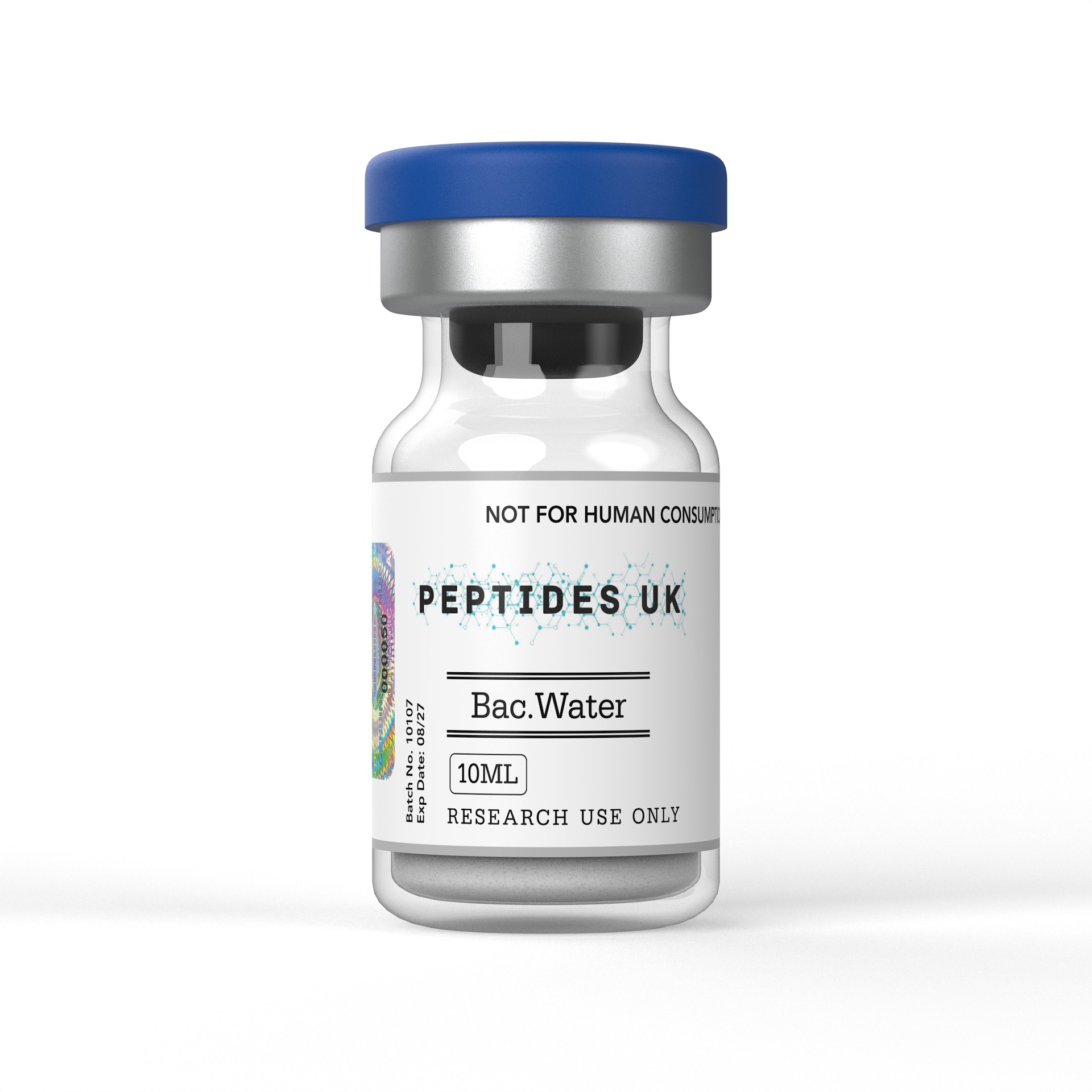
Last updated: April 2026 · UK research-grade reference · For laboratory research use only — not for human consumption
Table of Contents
- 1. Dosing framing for BPC-157 research
- 2. Preclinical dose range — the published spectrum
- 3. Reconstitution protocol
- 4. Injection routes — IP, IM, SC
- 5. Frequency and duration
- 6. Storage and aliquoting
- 7. Dose selection by research model
- 8. Dose-response characteristics
- 9. Half-life and pharmacokinetics
- 10. Combination with TB-500 or other peptides
- 11. UK procurement and quality
- 12. Frequently asked questions
- 13. References
1. Dosing framing for BPC-157 research
BPC-157 (15-amino-acid pentadecapeptide, sequence GEPPPGKPADDAGLV) is an investigational peptide. For UK-based laboratory research — in vitro, ex vivo, licensed animal work — protocol design requires careful specification of dose, route, frequency and duration. This guide aggregates the published preclinical dosing conventions and offers design considerations for UK research scientists.
2. Preclinical dose range — the published spectrum
Published rodent doses, roughly ordered:
- 10 ng/kg (0.01 µg/kg): low-end effective dose reported in some models
- 100 ng/kg (0.1 µg/kg): frequently studied
- 1 µg/kg: commonly used
- 10 µg/kg: most frequently cited literature dose
- 100 µg/kg: high-end of typical dose range
- > 100 µg/kg: used in some high-dose safety studies
The 10 µg/kg dose is the most common reference point across tendon, ligament, muscle, and GI protection protocols.
3. Reconstitution protocol
BPC-157 is supplied lyophilised. The standard diluent is bacteriostatic water for injection — its 0.9% benzyl alcohol preservative content permits multi-week storage of the reconstituted peptide at 2-8°C without microbial risk. Sterile water is an alternative for single-use preparation.
Example reconstitution math for a 5 mg vial:
- 1 ml diluent → 5 mg/ml (high-concentration)
- 2 ml diluent → 2.5 mg/ml (common research reference)
- 5 ml diluent → 1 mg/ml (dilute, smaller-aliquot friendly)
Reconstitution procedure:
- Swab vial rubber seal with alcohol wipe.
- Inject the bacteriostatic water slowly down the inner vial wall — do not spray directly onto the lyophilised cake.
- Swirl gently; do not shake. Full dissolution typically takes 30-60 seconds.
- Inspect clarity; solution should be clear with no visible particulates.
4. Injection routes — IP, IM, SC
Published routes in rodent studies:
- Intraperitoneal (IP): most common in rodent work; rapid systemic distribution.
- Intramuscular (IM): also well-studied; slightly slower absorption, sustained exposure.
- Subcutaneous (SC): less common in foundational rodent studies but used in some protocols.
- Oral gavage: several studies report retained activity orally (discussed in BPC-157 oral vs injectable research post).
Route selection should align with the research model: IP is standard for most rodent systemic dosing; IM is preferred for studies where local distribution near a peripheral injury site is a design consideration.
5. Frequency and duration
Typical rodent study dosing frequencies:
- Daily (most common) — appropriate for 7-30 day healing protocols
- Twice-daily — used in some acute-phase studies
- Every other day — occasionally used with higher per-dose amounts
Duration by protocol type:
- Acute injury models (tendon transection, muscle injury): 7-21 days
- Chronic or progressive models: 21-60 days
- Long-term safety studies: extended dosing windows up to 90 days in some protocols
6. Storage and aliquoting
Storage reference conditions:
- Lyophilised BPC-157 (unopened vials): 2-8°C; −20°C for extended-storage; avoid freeze-thaw of solid peptide beyond transfer-to-storage.
- Reconstituted in bacteriostatic water: 2-8°C protected from light; approximately 28 days stable (verify against COA for each batch).
- Reconstituted in sterile water (no preservative): use same day; otherwise aliquot and freeze at −20°C.
- Aliquoted for freeze storage: split into single-use microtube aliquots; freeze at −20°C (−80°C preferred for long-term).
Pragmatic workflow for a 5 mg vial supporting a 4-week study:
- Reconstitute in 2 ml bacteriostatic water → 2.5 mg/ml.
- Keep working vial at 2-8°C, protected from light.
- Draw daily doses sterilely.
- At week 3-4 if any peptide remaining, assess clarity and stability; discard if signs of degradation (cloudiness, particulates, precipitate).
7. Dose selection by research model
Representative protocol doses by endpoint:
- Achilles tendon transection (rat): 10 µg/kg IP daily for 14-21 days
- MCL transection (rat): 10 µg/kg IP daily for 30 days
- Muscle crush injury (rat): 10 µg/kg IP or IM daily for 7-14 days
- Gastric ulcer (rat): doses from 10 ng/kg through 10 µg/kg evaluated; 10 µg/kg is most commonly cited
- Colitis model (rat): 10 µg/kg IP daily or oral equivalent
- Cardiac ischaemia-reperfusion (rat): 10 µg/kg IP single or repeated dosing
For dose-ranging studies, a typical design uses 1 µg/kg, 10 µg/kg and 100 µg/kg arms to capture the central dose range.
8. Dose-response characteristics
Published dose-response for BPC-157 across tissue repair endpoints is notably flat — effect magnitudes at 1 µg/kg, 10 µg/kg and 100 µg/kg are frequently similar. This has been interpreted as reflecting saturation of the receptor-level mechanism at relatively low doses. For research protocol design, this means:
- Increasing the dose beyond 10-100 µg/kg typically does not produce proportional efficacy gains.
- The lowest effective dose in a model is often the most pharmacologically informative for mechanism work.
- For dose-response characterisation, testing doses spanning 3+ log units (e.g., 10 ng/kg, 1 µg/kg, 100 µg/kg) is more informative than testing closely-spaced doses.
9. Half-life and pharmacokinetics
BPC-157 pharmacokinetic characterisation in rodents has suggested a relatively short serum half-life (minutes to a few hours) but prolonged pharmacodynamic effects relative to that half-life — a phenomenon consistent with peptides that trigger sustained downstream signalling events even after rapid clearance. Rigorous human PK data are not available given the absence of completed clinical trials.
The practical implication for protocol design: daily dosing is adequate despite the short serum half-life, because the downstream tissue-repair effects persist well beyond direct peptide presence.
10. Combination with TB-500 or other peptides
Some protocols combine BPC-157 with TB-500 on the reasoning that their complementary mechanisms (VEGFR2/FAK vs actin cytoskeleton regulation) should compound. Evidence for additive vs synergistic effect in rigorous factorial designs is limited. For a rigorous combination study, a 2×2 factorial (vehicle / BPC-157 alone / TB-500 alone / combination) is the minimum design.
See our BPC-157 vs TB-500 comparison for the mechanism contrast and TB-500 UK Research Guide for TB-500-specific dosing reference.
11. UK procurement and quality
UK research-grade BPC-157 procurement requirements:
- ≥ 98% HPLC (≥ 99% emerging 2026 standard)
- Identity confirmed by MS per batch
- Batch-specific COA with full analytical data
- Lyophilised format, UK cold-chain dispatch
- Endotoxin testing for cell/animal work batches
See our Research-Grade Peptides Guide for standards detail and UK Research Peptide Buying Guide for sourcing due diligence.
12. Frequently asked questions
What is the most common BPC-157 dose in preclinical studies?
10 µg/kg daily, administered IP or IM, for 14-21 days in tendon and ligament healing models. This is the most cited protocol reference.
How do I reconstitute a 5 mg BPC-157 vial?
Add 2 ml bacteriostatic water to the vial slowly down the inner wall, swirl gently (do not shake), inspect for clarity. Result: 2.5 mg/ml.
How long is reconstituted BPC-157 stable?
In bacteriostatic water at 2-8°C, approximately 28 days is the common reference. Batch-specific COA should be consulted for each supply.
Should I use IP, IM or SC injection?
IP is the most common rodent research route. IM is an alternative with slightly sustained absorption. SC is used in some protocols. Route selection depends on the specific model — most replicated rodent studies use IP or IM.
How long should I dose in a tendon injury study?
14-21 days covers the inflammatory and early proliferative healing phases. Longer protocols (up to 30 days) extend into the remodelling phase. Shorter protocols (7 days) focus on the early inflammatory phase.
Can I use saline to reconstitute BPC-157?
Bacteriostatic water (preserved) or sterile water (single-use) are the standard research diluents. Saline is used occasionally but introduces ionic interactions that are not the default research choice.
Do I need dose-escalation with BPC-157?
Unlike GLP-1-class molecules, BPC-157 does not require dose-escalation in preclinical protocols — it is typically administered at target dose from day 1. This reflects a different safety and tolerability profile.
13. References
- Staresinic M, Sebecic B, Patrlj L, et al. Gastric pentadecapeptide BPC 157 accelerates healing of transected rat Achilles tendon. J Orthop Res 2003;21(6):976-983.
- Krivic A, Anic T, Seiwerth S, et al. Achilles detachment in rat and stable gastric pentadecapeptide BPC 157. J Orthop Res 2006;24(5):982-989.
- Chang CH, Tsai WC, Lin MS, et al. The promoting effect of pentadecapeptide BPC 157 on tendon healing. J Appl Physiol 2011;110(3):774-780.
- Cerovecki T, Bojanic I, Brcic L, et al. Pentadecapeptide BPC 157 (PL 14736) improves ligament healing. J Orthop Res 2010;28(9):1155-1161.
- Sikirić P, Seiwerth S, Rucman R, et al. Stable Gastric Pentadecapeptide BPC 157 — Current Status in Wound Healing. Curr Pharm Des 2018;24(18):1972-1989.
- Gwyer D, Wragg NM, Wilson SL. Gastric pentadecapeptide body protection compound BPC 157 and its role in accelerating musculoskeletal soft tissue healing. Cell Tissue Res 2019;377(2):153-159.
- Seiwerth S, Milavic M, Vukojevic J, et al. Stable Gastric Pentadecapeptide BPC 157 and Wound Healing. Front Pharmacol 2021;12:627533.
- Sikirić P, Seiwerth S, Rucman R, et al. Brain-gut Axis and Pentadecapeptide BPC 157. Curr Neuropharmacol 2016;14(8):857-865.
- Huang T, Zhang K, Sun L, et al. Body protective compound-157 enhances wound healing in vivo and promotes angiogenesis in vitro. Drug Des Devel Ther 2015;9:2485-2499.
- Hsieh MJ, Liu HT, Wang CN, et al. Therapeutic potential of pro-angiogenic BPC157 is associated with VEGFR2 activation. J Mol Med 2017;95(3):323-333.
UK Research Cluster Hubs
- BPC-157 UK Research Guide
- TB-500 UK Research Guide
- GLP-1 Peptides Complete Research Reference
- Retatrutide UK Research Guide
- Tirzepatide UK Research Guide
- Research-Grade Peptides Standards Guide
- UK Research Peptide Buying Guide
Disclaimer: BPC-157 is an investigational peptide not approved for human use in the UK, EU or US. All products supplied by Peptides Lab UK are for licensed in vitro and ex vivo laboratory research purposes only. Not for human consumption, veterinary use, or any therapeutic application.