




No products in the cart.

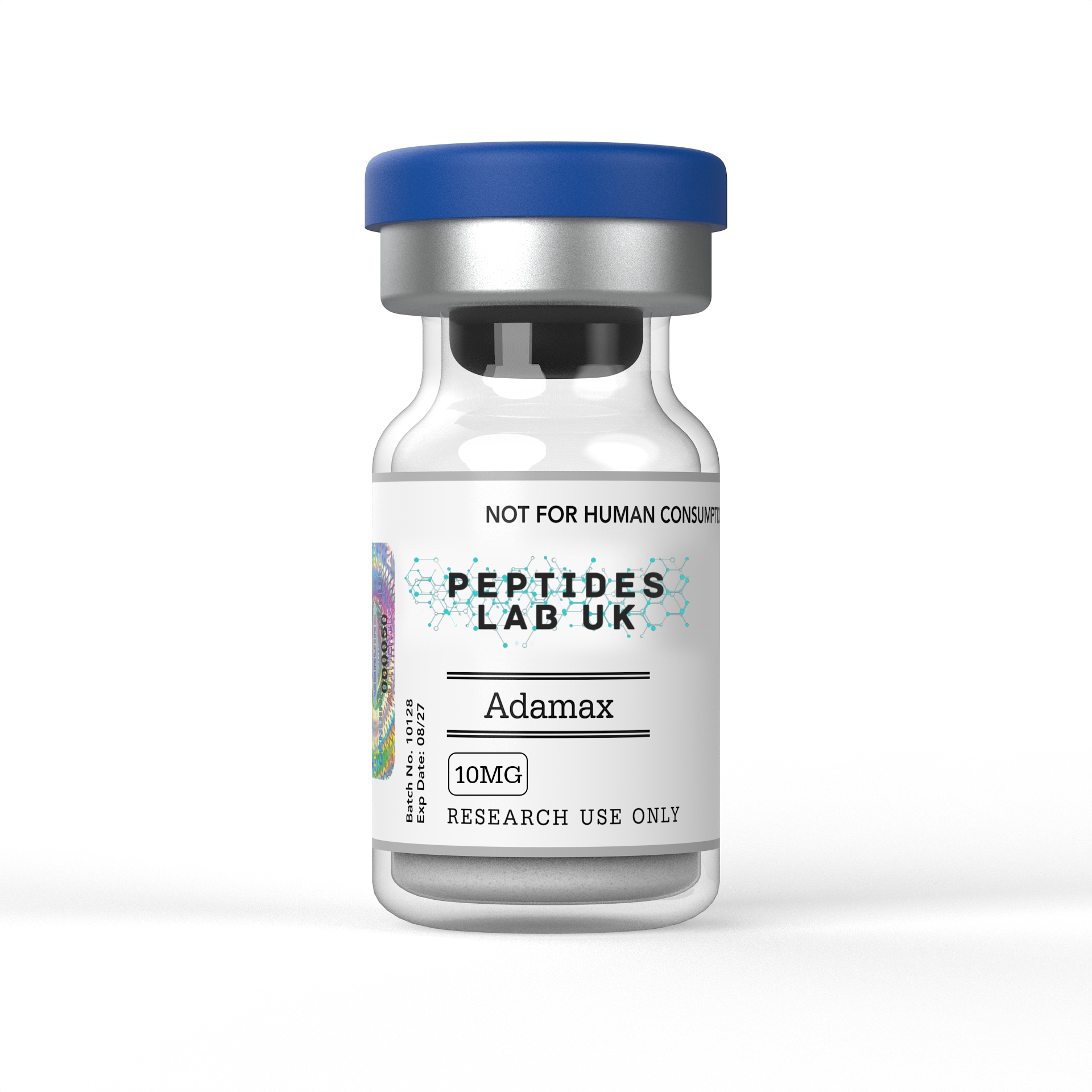
Adamax For Lab Research
£79.00
Login for member prices★★★★★
✔︎ Quality checked
✔︎ Third party verified
Adamax is a synthetic peptide for laboratory and in vitro research applications. Supplied at high purity with a full third-party COA on request. For laboratory and in vitro research use only. Not for human consumption. Not a medicine.
Looking for a Certificate of Analysis?
If you are looking for a Certificate Of Analysis, please email research@peptideslabuk.com to have it sent to you.
Please Note: Many sites are displaying counterfeit COAs, so ours is provided upon request.
If you are looking for a Certificate Of Analysis, please email research@peptideslabuk.com to have it sent to you.
Please Note: Many sites are displaying counterfeit COAs, so ours is provided upon request.
You may also like…
-
Login for member prices

-
Login for member prices
-
Login for member prices
Product Description
Buy Adamax Peptide UK – >99% Purity | Next-Generation Semax Analog | Research Use Only
Adamax (Ac-Semax-Ad, Ac-MEHFPGP-Ad-NH₂) is a next-generation synthetic nootropic peptide — an advanced structural hybrid of Semax and P21, engineered to combine Semax’s established BDNF-upregulating and neuroprotective properties with P21’s adamantane modification for significantly enhanced blood-brain barrier penetration and metabolic stability. Buy Adamax peptide in the UK from Peptides Lab UK with >99% HPLC-verified purity, batch-specific COA, and fast UK dispatch for laboratory and in-vitro research use only.
What is Adamax Peptide?
Adamax is a synthetic 9-amino acid nootropic research peptide, created by combining two well-characterised structural elements:
- The Semax backbone — Met-Glu-His-Phe-Pro-Gly-Pro (MEHFPGP), a synthetic heptapeptide analog of adrenocorticotropic hormone (ACTH) fragment 4–10, originally developed at the Russian Academy of Sciences and approved in Russia for clinical use in stroke therapy and cognitive disorders. Semax carries an extensive body of pre-clinical and clinical research confirming BDNF upregulation, TrkB receptor activation, neuroprotection, and cognitive enhancement in both animal and human studies.
- The adamantane modification from P21 — the same lipophilic adamantylglycine modification used in P21 (P021), added at the C-terminus to dramatically increase lipophilicity, enhance blood-brain barrier (BBB) penetration, and confer resistance to enzymatic degradation. This modification is also responsible for the peptide’s name — “Adam” from adamantane, combined with the “ax” suffix.
The N-terminus carries an acetyl group (Ac-), providing additional protection against proteolytic breakdown — the same modification found in N-Acetyl Semax, creating a more stable intermediate form that persists longer in biological environments.
The result is a compound that — in pre-clinical and in-silico models — is hypothesised to deliver Semax’s well-validated neurobiological effects with meaningfully improved CNS bioavailability and duration of action, making it a compelling research tool for laboratories investigating cognitive, neuroprotective, and neurogenic pathways.
Product Specifications:
| Parameter | Specification |
|---|---|
| IUPAC Sequence | Ac-Met-Glu-His-Phe-Pro-Gly-Pro-Ad-NH₂ |
| Synonyms | Ac-Semax-Ad, Adamax Peptide, N-Acetyl Semax Adamantyl |
| Molecular Weight | ~1,100–1,300 g/mol (depending on adamantyl configuration) |
| CAS | Not yet assigned (novel research analog) |
| Purity | >99% (HPLC verified) |
| Form | Lyophilised powder |
| Storage | –20°C (long-term), 2–8°C (short-term, reconstituted) |
| Solubility | Bacteriostatic water, sterile water |
How Does Adamax Work?
Adamax’s proposed mechanism is built on the well-validated pharmacology of its two parent components — Semax and the P21 adamantane modification:
BDNF Upregulation and TrkB Activation: Semax is one of the most thoroughly studied BDNF-upregulating peptides in neuroscience literature. Published studies confirm that a single intranasal application of Semax produces a 1.4-fold increase in BDNF protein levels and a 3-fold increase in BDNF mRNA expression in the rat hippocampus, accompanied by a 1.6-fold increase in TrkB phosphorylation. Adamax is hypothesised to replicate and extend this effect, with its adamantane modification providing improved BBB penetration for more efficient central delivery.
Elevated BDNF/TrkB signalling downstream activates:
- PI3K/Akt pathway — promoting neuronal survival and resistance to apoptosis
- MAPK/ERK pathway — supporting synaptic plasticity and long-term potentiation (LTP)
- PLC-γ pathway — modulating neurotransmitter release and neuronal excitability
Neurotransmitter Modulation: Semax research confirms it rapidly activates serotonergic and dopaminergic brain systems. Adamax is studied for similar interactions with dopamine, norepinephrine, and serotonin pathways — which may contribute to research observations of improved focus, motivation, and mood regulation in pre-clinical models.
Enhanced BBB Penetration via Adamantane: The adamantane moiety at the C-terminus significantly increases the compound’s lipophilicity (log P), enabling more efficient passive diffusion across the blood-brain barrier compared to unmodified Semax. The same modification in P21 was specifically validated for this purpose, with confirmed BBB penetration in animal models.
N-Acetyl Stability Enhancement: The N-terminal acetyl group protects against aminopeptidase-mediated degradation at the N-terminus, extending the peptide’s plasma half-life and increasing the proportion of intact compound reaching the CNS.
What Does Adamax Do in Research?
Adamax is a relatively new research compound with no independent published studies as of 2025 — an important transparency note that reflects its status as a novel designer peptide. Its research profile is currently built on the well-established pharmacology of its constituent elements, pre-clinical observations, and in-silico modelling:
Derived from Semax Research:
- BDNF and NGF upregulation — confirmed in rat hippocampus, frontal cortex, and basal forebrain in multiple Semax studies; Adamax is studied for equivalent or enhanced effects due to its structural modifications
- Cognitive enhancement — Semax-treated animals showed significant increases in conditioned avoidance reactions and improvements in learning and memory formation; researchers study whether Adamax replicates this with greater potency
- Neuroprotection in ischemia models — Semax is approved for acute stroke therapy in Russia; Adamax is studied in ischemia-adjacent neuroprotection models for its BDNF-mediated protective effects
- Stroke research applications — clinical data confirms Semax administration increased BDNF plasma levels in ischemic stroke patients, with improvements in Barthel index motor performance; Adamax neurogenic studies draw on this foundation
- Anti-inflammatory CNS signalling — Semax shifts neuroinflammatory balance toward anti-inflammatory agents including IL-10, reducing IL-8 and CRP in ischemic models; Adamax is studied for comparable pathway modulation
Derived from Adamantane/P21 Research:
- Superior BBB penetration — the adamantane modification is specifically validated in P21 research for dramatically improving CNS delivery of peptides that would otherwise show poor central bioavailability
- Improved metabolic stability — adamantylation protects peptide bonds from enzymatic degradation, extending effective half-life in biological research environments
- Potential Alzheimer’s-adjacent neuroprotection — P21’s adamantane structure contributes to Adamax’s research relevance in models examining beta-amyloid and tau pathology, as the adamantane group may contribute additional CNS-protective properties
Additional Research Areas Under Investigation:
- Hippocampal neurogenesis — BDNF upregulation is closely linked to dentate gyrus neurogenesis, and Adamax is studied in models examining new neuron formation and synaptic plasticity
- Physical endurance models — pre-clinical observations suggest Adamax may enhance physical endurance research applications markers at 2–3× the rate of Semax analogs without the adamantane modification, attributed to its improved BBB penetration and sustained CNS activity
- Analgesic pathway research — Semax has been studied for modulation of opioid-related pain pathways; Adamax is examined for similar interactions in inflammatory pain models
What Do Studies Say? Research Citations for Adamax’s Parent Compounds
Important transparency note: Adamax as a standalone compound has no independent published studies indexed on PubMed as of 2025. It is a novel designer peptide and should be treated strictly as a research compound. The citations below relate to its constituent parent compounds — Semax and the P21 adamantane modification — which form the scientific basis for Adamax research:
Semax — Foundational Research:
- Dolotov OV et al. (2006) — Journal of Neurochemistry, 100(2): 470–479 (PubMed: 16996037) — Confirmed a single Semax application (50 μg/kg) produces a 1.4-fold increase in hippocampal BDNF protein, 1.6-fold increase in TrkB phosphorylation, and 3-fold increase in BDNF mRNA. Treated animals showed significant increases in conditioned avoidance reactions. DOI: 10.1111/j.1471-4159.2006.04213.x
- Stavchansky VV et al. (2024) — PMC11498467 / Journal of Neurochemistry — Confirmed that both Semax and its PGP fragment activate transcription of BDNF, NGF, TrkA, TrkB, and TrkC in ischemic rat cortex, with BDNF and TrkC upregulation confirmed at 3 hours post-occlusion. Established the neurotrophin expression basis for Semax’s neuroprotective and cognitive effects in ischemia models.
- Dolotov OV et al. (2006) — PubMed 16635254 — Demonstrated specific Semax binding sites in rat basal forebrain (KD = 2.4 nM) with rapid BDNF protein increase at 3 hours post-intranasal administration. Established that Semax’s cognitive effects are associated with elevated BDNF in the basal forebrain.
- Khomenko IP et al. (2018) — PubMed 29798983 — Human clinical study in 110 ischemic stroke patients confirming that Semax administration increased BDNF plasma levels throughout the study period, positively correlated with improved Barthel index scores and motor performance research applications.
P21 Adamantane Modification:
- Li B et al. (2010) — FEBS Letters, 584(15): 3359–3365 (PubMed: 20600046) — Original study validating the adamantylglycine modification in P21, confirming it enables BBB penetration and neurogenic activity not seen in unmodified parent sequences. Demonstrated enhanced memory, neurogenesis, and synaptic marker upregulation in adult mice.
- Baazaoui N & Iqbal K (2017) — Alzheimer’s Research & Therapy, 9(1): 45 — Confirmed P21’s adamantane-enabled CNS delivery rescued cognitive impairment and prevented neurodegeneration for up to 18 months in 3xTg-AD mouse models. DOI: 10.1186/s13195-017-0273-7Note: All Semax citations relate to Semax itself (the parent compound), not Adamax specifically. Adamax has not undergone independent published peer-reviewed evaluation. All research on Adamax is pre-clinical and/or anecdotal, and it is supplied strictly for laboratory and in-vitro research use only.
What is Adamax Used For in Research?
Researchers purchasing Adamax from UK peptides suppliers like Peptides Lab UK typically investigate:
- BDNF pathway modulation and TrkB receptor sensitivity studies
- Hippocampal neurogenesis and synaptic plasticity models
- Neuroprotection in ischemia and excitotoxicity research models
- Cognitive enhancement pathway research in rodent models
- BBB penetration and CNS peptide delivery optimisation studies
- Neurotransmitter system modulation: dopamine, serotonin, norepinephrine
- Comparative nootropic peptide studies alongside Semax, Selank, P21, and Cerebrolysin
- Adamantane modification and its contribution to peptide bioavailability research
- Neurodegeneration models: Alzheimer’s-adjacent tau and amyloid pathway studies
- Structure–activity relationship (SAR) research in the ACTH analog peptide class
Adamax vs Semax vs N-Acetyl Semax – Research Comparison
| Feature | Adamax | N-Acetyl Semax | Semax |
|---|---|---|---|
| Base Sequence | ACTH(4–7) + PGP + adamantylGly | ACTH(4–7) + PGP | ACTH(4–7) + PGP |
| N-Terminal Modification | Acetyl (Ac-) | Acetyl (Ac-) | None |
| C-Terminal Modification | Adamantylglycine | None | None |
| BBB Penetration | Enhanced (lipophilic adamantane) | Moderate (acetyl improved) | Moderate |
| Metabolic Stability | Enhanced (dual protection) | Improved vs Semax | Shorter half-life |
| Published PubMed Studies | None (novel compound) | Limited | Extensive |
| BDNF Upregulation | Hypothesised (parent-derived) | Confirmed (Semax-based) | Confirmed |
Adamax represents the most structurally advanced iteration of the Semax analog series, though its independent research base is currently limited to pre-clinical and anecdotal observation.
Quality & Purity Assurance
Every batch of Adamax from Peptides Lab UK is:
- >99% pure — HPLC and mass spectrometry verified
- Supplied with a full Certificate of Analysis (COA) on request
- Lyophilised powder for maximum stability and long shelf life
- Manufactured under strict, controlled laboratory conditions
- Consistent batch-to-batch quality for reproducible research results
Why Buy Adamax from Peptides Lab UK?
When you buy Adamax peptide UK from Peptides Lab UK, you receive:
99% purity, HPLC and MS verified, third-party tested
- Full COA documentation per batch
- Fast same-day UK dispatch with tracked delivery
- Competitive pricing with bulk research discounts available
- Trusted by researchers across the UK and Europe
Research Disclaimer: All products supplied by Peptides Lab UK are intended strictly for in-vitro laboratory research and scientific study use only. They are not intended for human consumption, veterinary use, or any medical or therapeutic application. Adamax is a novel designer research peptide with no independent published clinical or pre-clinical studies indexed on PubMed. All mechanistic descriptions are based on the pharmacology of its parent compounds (Semax and P21) and do not constitute a claim of established efficacy for Adamax as a standalone compound. Adamax has not been evaluated by the MHRA or any regulatory authority for safety or efficacy in humans or animals. Peptides Lab UK accepts no liability for any misuse of research compounds. By purchasing, you confirm that you are a qualified researcher and that the product will be used solely within a controlled laboratory environment in compliance with all applicable UK laws, regulations, and institutional guidelines.
Related products
-
Login for member prices£119.00 Select options This product has multiple variants. The options may be chosen on the product page
-
Login for member prices
-
Login for member prices
