




No products in the cart.

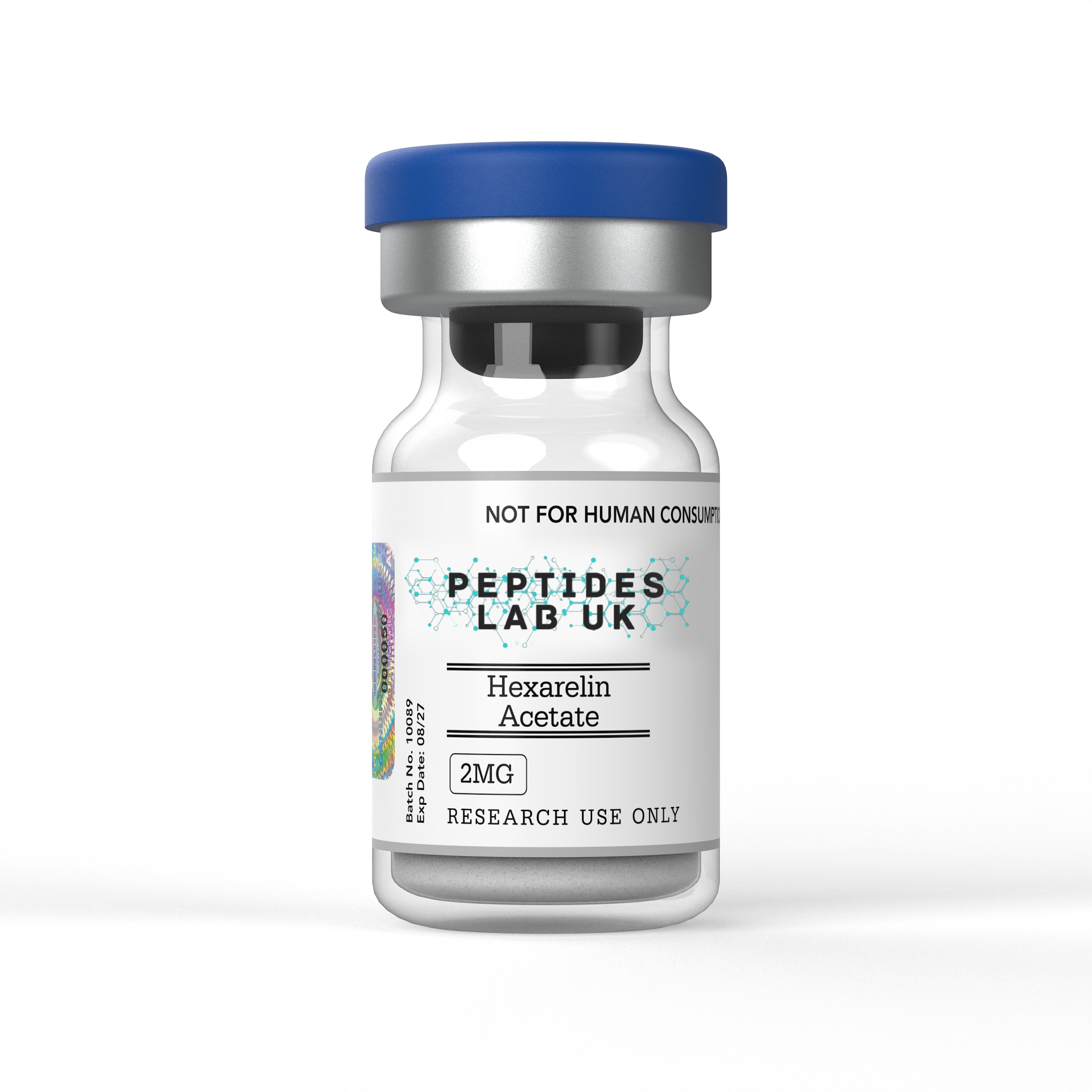
Hexarelin Acetate For Lab Research
£37.99
Login for member prices★★★★★
✔︎ Quality checked
✔︎ Third party verified
Hexarelin Acetate is a synthetic hexapeptide growth hormone secretagogue for laboratory and in vitro research. Produced at >99% purity with a full COA. For laboratory and in vitro research use only. Not for human consumption. Not a medicine.
Looking for a Certificate of Analysis?
If you are looking for a Certificate Of Analysis, please email research@peptideslabuk.com to have it sent to you.
Please Note: Many sites are displaying counterfeit COAs, so ours is provided upon request.
If you are looking for a Certificate Of Analysis, please email research@peptideslabuk.com to have it sent to you.
Please Note: Many sites are displaying counterfeit COAs, so ours is provided upon request.
You may also like…
-
Login for member prices
-
Login for member prices
Product Description
Hexarelin Acetate Peptide | Buy Hexarelin UK | High-Purity GHRP Research Peptide
Hexarelin Acetate is a synthetic hexapeptide growth hormone secretagogue (GHS) and potent analogue of GHRP-6, studied extensively in laboratory research for its role in GH release, GHS receptor binding, cardiac function, and lipid metabolism — available to buy in the UK from Peptides Lab UK in high-purity lyophilised form.
Distributed by Peptides Lab UK in a high-purity lyophilised format, for laboratory research use only. This compound is handled in controlled settings for in vitro and pre-clinical studies, with no applications in human or veterinary medicine. Each batch undergoes rigorous quality analysis to ensure >99% purity (HPLC verified).
What Is Hexarelin Acetate?
Hexarelin Acetate (His-D-2-Methyl-Trp-Ala-Trp-D-Phe-Lys-NH₂) is a synthetic six-amino acid peptide belonging to the growth hormone releasing peptide (GHRP) family. It was developed as a structurally more stable analogue of GHRP-6, incorporating a 2-Methyl-Tryptophan substitution for improved chemical stability. Hexarelin acts primarily via the GHS receptor (GHS-R1a) in the hypothalamus and pituitary, and has additionally been found to bind to a distinct receptor subtype in cardiac and peripheral tissues — making it a uniquely broad research compound within the GHRP class.
As a research compound, Hexarelin UK is one of the most studied synthetic GHRPs, with a rich body of pre-clinical and in vitro literature spanning neuroendocrinology, cardiovascular biology, and metabolic research.
What Does Hexarelin Acetate Do in Research?
In laboratory settings, Hexarelin has been studied for its interactions with GHS receptors and its downstream effects across multiple biological systems. Research has examined its role in:
- Stimulating GH and IGF-1 secretion via GHS-R1a in the hypothalamus and pituitary
- Binding to a distinct cardiac GHS receptor subtype independent of GH axis activity
- Investigating cardiovascular performance and cardioprotective pathways
- Modulating lipid metabolism and energy balance via the CD36 receptor
- Studying synergistic interactions with GHRH in GH secretion models
- Examining somatostatin tone and GH pulsatility in in vivo models
Hexarelin and GH Secretion Research
Research confirms that Hexarelin is a potent GH secretagogue active after successive doses, and demonstrates synergism when co-administered with GHRH — with combined peak GH secretion rates significantly exceeding the arithmetic sum of each administered separately.
Hexarelin and GHS Receptor Distribution Research
A detailed radioreceptor analysis using radiolabelled Hexarelin found GHS receptors distributed across a wide range of human tissues, with the highest binding activity detected in the myocardium, followed by adrenal glands, gonads, arteries, lung, liver, and skeletal muscle — and evidence suggesting a peptidyl GHS-specific receptor subtype distinct from the classical GHS-R1a may exist in cardiac tissue.
Hexarelin and IGF-1 Research
Research examining Hexarelin in pre-clinical models found it stimulated IGF-1 secretion, with serum levels rising significantly during the study period, alongside increases in linear growth velocity — findings that have informed subsequent research into GHRPs as GH axis modulators.
What Do Studies Say About Hexarelin Acetate?
Hexarelin has accumulated a substantial peer-reviewed research profile across GH biology, cardiovascular research, and metabolic science.
Hexarelin and Cardiac Function Research
A study published in Endocrinology examined the hemodynamic effects of Hexarelin in rats following experimental myocardial infarction, finding that higher-dose Hexarelin decreased total peripheral resistance and increased stroke volume — effects that paralleled those of recombinant human GH and were of significant interest in cardiovascular research models.
Hexarelin and Lipid Metabolism Research
Research published in PMC found that Hexarelin, acting as both a GH secretagogue and a CD36 ligand, increased pulsatile GH secretion, reduced fat mass, and improved lipid profiles in insulin-resistant mouse models — without compromising glucose metabolism — positioning it as a research compound of interest in metabolic disorder studies.
Hexarelin and GHRH Synergy Research
Studies in healthy adult males demonstrated that Hexarelin and GHRH are synergistic in stimulating GH secretion, with combined administration producing peak GH secretion rates greater than the sum of each agent administered in isolation — a finding with implications for the study of GH axis regulation.
Hexarelin Potency vs GHRP-6
Animal studies found that Hexarelin elicits GH release comparable to GHRP-6 at equivalent doses via intravenous administration, and demonstrated slightly greater effectiveness when delivered subcutaneously, producing a more prolonged GH release profile.
Key cited studies:
- Massoud AF et al. (1996) — Repeated Administration of Hexarelin and GHRH: GH Responsivity — Clin Endocrinol (Oxf). PubMed ID: 8762732
- Muccioli G et al. (2001) — GHS Binding Sites in Peripheral Human Tissues — PubMed ID: 11061542
- Laron Z et al. (1995) — GH-releasing Activity of Hexarelin in Infant and Adult Rats — PubMed ID: 7910650
- Johansson S et al. (1999) — Hexarelin Improves Cardiac Function After Experimental MI — PubMed ID: 10614623
- Leung KC et al. (2017) — Safety and Efficacy of GH Secretagogues — PMC5632578
- Lau et al. (2017) — Hexarelin Improves Lipid Metabolic Aberrations in Insulin-Resistant MKR Mice — PMC5659698
Buy Hexarelin Acetate UK — Product Specifications
| Property | Detail |
|---|---|
| Purity | >99% (HPLC verified) |
| Form | Lyophilised powder |
| Storage | Store dry at -20°C; protect from light |
| Solubility | Bacteriostatic water, sterile water, or suitable laboratory solvents |
Hexarelin Research Applications
Hexarelin Acetate peptide UK is supplied strictly for the following in vitro and pre-clinical research uses:
- GHS receptor binding and GH axis pathway studies
- GH and IGF-1 secretion modelling in pre-clinical models
- Cardiovascular and cardioprotective pathway research
- Lipid metabolism and energy balance studies via the CD36 receptor
- GHRP–GHRH synergy and somatostatin interaction studies
- Structure–activity relationship (SAR) investigations within the GHRP peptide class
Why Buy Hexarelin from Peptides Lab UK?
Peptides Lab UK is a trusted UK peptides supplier, providing research-grade compounds verified by independent HPLC testing. When you buy Hexarelin in the UK from us, you receive:
- >99% purity, batch-tested and HPLC verified
- Fast UK dispatch with discreet, secure packaging
- Lyophilised format for maximum compound stability
- Full compliance with UK research compound guidelines
Research Disclaimer This product is provided by Peptides Lab UK strictly for laboratory research use only. It is not intended for human consumption, medical use, or veterinary applications. Hexarelin Acetate is not a licensed medicine or drug. It has not been approved by the MHRA, FDA, or any other regulatory body for use in humans or animals. Handling should only be performed by qualified laboratory professionals in a controlled research setting. The information presented here is for scientific reference purposes only and should not be construed as medical advice or guidance.
Related products
-
Login for member prices

-
Login for member prices
-
Login for member prices
