




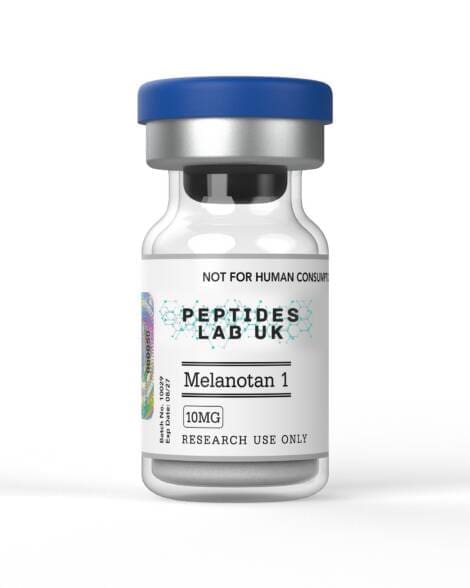


Buy Melanotan 1 (MT-1) For Lab Research
£49.99
Login for member prices★★★★★
✔︎ Quality checked
✔︎ Third party verified
Melanotan 1 (MT-1) is a linear alpha-MSH analogue for laboratory and in vitro research. Supplied at >99% purity with a full third-party Certificate of Analysis. For laboratory and in vitro research use only. Not for human consumption. Not a medicine.

Looking for a Certificate of Analysis?
If you are looking for a Certificate Of Analysis, please email research@peptideslabuk.com to have it sent to you.
Please Note: Many sites are displaying counterfeit COAs, so ours is provided upon request.
If you are looking for a Certificate Of Analysis, please email research@peptideslabuk.com to have it sent to you.
Please Note: Many sites are displaying counterfeit COAs, so ours is provided upon request.
You may also like…
-
Login for member prices Original price was: £89.99.£69.99Current price is: £69.99. Buy now
Buy GHK-Cu UK | HPLC-Verified Copper Peptide | COA – 100mg
Product Description
Melanotan 1 (MT-1) | Buy Melanotan 1 UK | Research Use Only
Melanotan 1 (MT-1) — also known as afamelanotide — is a synthetic linear analogue of alpha-melanocyte-stimulating hormone (α-MSH) that binds to melanocortin receptors, particularly MC1R, to stimulate eumelanin production in the skin. As a research peptide available to buy in the UK, MT-1 is the most studied melanocortin-class compound in pre-clinical and clinical photoprotection research, with a well-characterised receptor pharmacology and a purity-verified supply from Peptides Lab UK.
Distributed by Peptides Lab UK in lyophilised format, for laboratory and in vitro research use only. Each batch is independently verified at >99% purity by HPLC and mass spectrometry. Not intended for human or veterinary use.
What Is Melanotan 1 (MT-1)?
Melanotan 1 is a 13-amino acid synthetic peptide analogue of the endogenous hormone alpha-melanocyte-stimulating hormone (α-MSH), itself a cleavage product of pro-opiomelanocortin (POMC). It was originally developed by researchers at the University of Arizona as part of a programme to identify stable, receptor-selective melanocortin analogues suitable for photoprotection research.
Unlike native α-MSH, which has a very short plasma half-life due to rapid enzymatic degradation, MT-1 incorporates a linear sequence modification that significantly extends its stability in biological matrices while preserving high-affinity binding at melanocortin receptors — primarily MC1R, the receptor responsible for eumelanin synthesis in melanocytes.
MT-1 is distinct from Melanotan 2 (MT-2): MT-1 is a linear peptide with high MC1R selectivity, while MT-2 is a cyclic analogue with broader melanocortin receptor activity including MC3R and MC4R. This receptor selectivity profile makes MT-1 the preferred compound in photoprotection and pigmentation biology research.
An important note for the research community: afamelanotide is the INN (International Non-proprietary Name) assigned to Melanotan 1 following clinical development. In pre-clinical literature and research peptide contexts, MT-1 and afamelanotide refer to the same compound.
How Does Melanotan 1 Work?
MC1R Binding and Eumelanin Signalling
MT-1 exerts its primary pharmacological action by binding to the melanocortin 1 receptor (MC1R) on melanocytes in the skin. MC1R is a G-protein-coupled receptor (GPCR) that, upon agonist engagement, activates the Gs/adenylate cyclase pathway, increasing intracellular cAMP and activating PKA-linked signalling cascades that upregulate tyrosinase activity and drive eumelanin synthesis — the dark, UV-protective form of melanin.
Receptor Selectivity — MC1R vs MC3R/MC4R
MT-1 demonstrates high selectivity for MC1R relative to MC3R and MC4R compared to Melanotan 2. This receptor selectivity profile is the key pharmacological distinction between the two analogues, and makes MT-1 the reference compound in studies focused specifically on the MC1R/pigmentation axis without the confounding MC3R (energy homeostasis) and MC4R (appetite, sexual function) activity associated with MT-2.
Photoprotective Mechanism
The increase in eumelanin production stimulated by MC1R activation provides a photoprotective effect by increasing the skin’s natural UV-absorbing pigment content. In research models, this mechanism has been studied in the context of photoprotection in UV-sensitive conditions — particularly erythropoietic protoporphyria (EPP), where clinical development of afamelanotide as a subcutaneous implant has resulted in regulatory approval in Europe and the United States.
Extended Half-Life vs Native α-MSH
Native α-MSH has a plasma half-life of only a few minutes. MT-1’s structural modifications confer substantially improved resistance to enzymatic degradation, extending its research window and making it suitable for in vitro and pre-clinical receptor pharmacology studies where sustained receptor engagement is required.
What Does Melanotan 1 Do in Research?
In laboratory and pre-clinical settings, Melanotan 1 has been investigated across a range of melanocortin biology research areas, including:
- MC1R binding affinity, Gs/adenylate cyclase activation, and cAMP/PKA signalling pathway studies
- Eumelanin synthesis, tyrosinase upregulation, and melanocyte pigmentation biology
- Photoprotection and UV-induced DNA damage prevention models
- Melanocortin receptor selectivity profiling and SAR studies — comparison with α-MSH, MT-2, and NDP-α-MSH
- Erythropoietic protoporphyria (EPP) and porphyria photoprotection models
- Skin pigmentation and melanogenesis pathway research
- MC1R-mediated anti-inflammatory signalling in keratinocyte and immune cell models
- Comparative melanocortin analogue pharmacology — MT-1 vs MT-2 vs Bremelanotide
- Circadian and seasonal melanogenesis regulation studies
- Melanocortin system interactions with UV exposure and oxidative stress responses
What Do Studies Say About Melanotan 1?
Foundational Characterisation
The synthesis and initial characterisation of Melanotan 1 by Hadley and Dorr at the University of Arizona established it as a potent, stable MC1R agonist with substantially enhanced in vivo bioactivity compared to native α-MSH, and confirmed its capacity to stimulate melanogenesis in pre-clinical models. These foundational studies defined the receptor pharmacology that underpins all subsequent MT-1 research.
Key Citation
Hadley ME & Dorr RT (2006) — Melanocortin peptide therapeutics: historical milestones, clinical studies and commercialisation — Peptides 27(4):921–930. DOI: 10.1016/j.peptides.2005.01.029
Clinical Development — Afamelanotide and EPP
Afamelanotide (MT-1), delivered as a subcutaneous slow-release implant, has been studied in multiple randomised controlled trials in patients with erythropoietic protoporphyria (EPP). Clinical studies demonstrated significant increases in pain-free sun exposure time compared to placebo, supporting the photoprotective efficacy of sustained MC1R stimulation. Afamelanotide received EMA approval in Europe (2014) and FDA approval in the United States (2019) for EPP — making it the only melanocortin peptide to reach full regulatory approval to date.
Key Citations
Langendonk JG et al. (2015) — Afamelanotide for Erythropoietic Protoporphyria — N Engl J Med 373(1):48–59. DOI: 10.1056/NEJMoa1411481
Biolcati G et al. (2015) — Long-term observational study of afamelanotide in 115 patients with erythropoietic protoporphyria — Br J Dermatol 172(6):1601–1612. DOI: 10.1111/bjd.13598
MC1R Selectivity and Receptor Pharmacology
Comparative receptor binding studies have confirmed MT-1’s preferential activity at MC1R versus the broader receptor profile of MT-2, establishing it as the reference compound for isolated MC1R pathway research. Studies in melanocyte cell lines and receptor-transfected systems have characterised the cAMP signalling response, tyrosinase induction, and melanin output associated with MT-1 receptor engagement.
Anti-Inflammatory MC1R Signalling
Pre-clinical research has identified MC1R-mediated anti-inflammatory pathways activated by MT-1 in keratinocyte and macrophage models, including NF-κB suppression and anti-oxidant gene induction — suggesting research utility beyond melanogenesis in inflammatory skin biology models.
Melanotan 1 vs Other Melanocortin Research Peptides
| Feature | Melanotan 1 (MT-1) | Melanotan 2 (MT-2) | α-MSH (Native) |
| Structure | Linear 13-AA | Cyclic 7-AA | Linear 13-AA |
| Primary Receptor | MC1R (high selectivity) | MC1R, MC3R, MC4R | MC1R, MC3R, MC4R |
| Eumelanin Stimulation | High | High | Moderate |
| Half-Life | ~1–2 hours | ~1–2 hours | < 5 minutes |
| MC4R Activity | Minimal | Significant | Moderate |
| Clinical Approval | Yes (EPP — afamelanotide) | No | No |
| Best Research Use | Pigmentation, photoprotection, MC1R pharmacology | Broad melanocortin axis, MC4R pathway | Endogenous reference standard |
Buy Melanotan 1 UK — Product Specifications
| Property | Detail |
| Full Name | Melanotan 1 / Afamelanotide |
| Also Known As | MT-1, α-MSH analogue, CUV1647 (implant form) |
| Sequence | Ac-Ser-Tyr-Ser-Met-Glu-His-Phe-Arg-Trp-Gly-Lys-Pro-Val-NH₂ |
| Amino Acids | 13 |
| Molecular Weight | 1,646.9 g/mol |
| Molecular Formula | C₇₈H₁₁₁N₂₁O₁₉S |
| Primary Receptor | MC1R (melanocortin 1 receptor) |
| Effective Half-Life | ~1–2 hours |
| Purity | >99% (HPLC and MS verified) |
| Form | Lyophilised powder |
| Storage | Store dry at -20°C; protect from light and moisture |
| Solubility | Bacteriostatic water, sterile water, or suitable research solvents |
Quality & Purity Assurance
Every batch of Melanotan 1 from Peptides Lab UK is:
- >99% pure — HPLC and mass spectrometry verified
- Supplied with a full Certificate of Analysis (COA) available on request
- Lyophilised powder format for maximum stability and extended shelf life
- Manufactured under strictly controlled laboratory conditions
- Consistent batch-to-batch quality for reproducible research outcomes
Why Buy Melanotan 1 from Peptides Lab UK?
Peptides Lab UK is a trusted UK peptides supplier, providing research-grade compounds verified by independent HPLC testing. When you buy Melanotan 1 in the UK from Peptides Lab UK, you receive:
- >99% purity, HPLC and MS verified, third-party tested
- Full COA documentation per batch
- Fast same-day UK dispatch with tracked delivery
- Competitive pricing with bulk research discounts available
- Trusted by researchers across the UK and Europe
Research Disclaimer
All products supplied by Peptides Lab UK are intended strictly for in vitro laboratory research and scientific study use only. They are not intended for human consumption, veterinary use, or any medical or therapeutic application. Melanotan 1 (MT-1 / afamelanotide) is not available as a licensed medicine in the UK for general use and is supplied here solely as a research-grade peptide for controlled laboratory settings. This compound is not approved by the MHRA or FDA for self-administration or clinical use outside of approved clinical trial frameworks. All research citations on this page relate to pre-clinical studies and peer-reviewed pharmacological research and do not constitute a claim of safety or therapeutic efficacy. Peptides Lab UK accepts no liability for any misuse of research compounds. By purchasing, you confirm that you are a qualified researcher and that the product will be used solely within a controlled laboratory environment in compliance with all applicable UK laws, regulations, and institutional guidelines.
Related products
-
Login for member prices

-
Login for member prices
-
Login for member prices
