



No products in the cart.
Up to - 30%

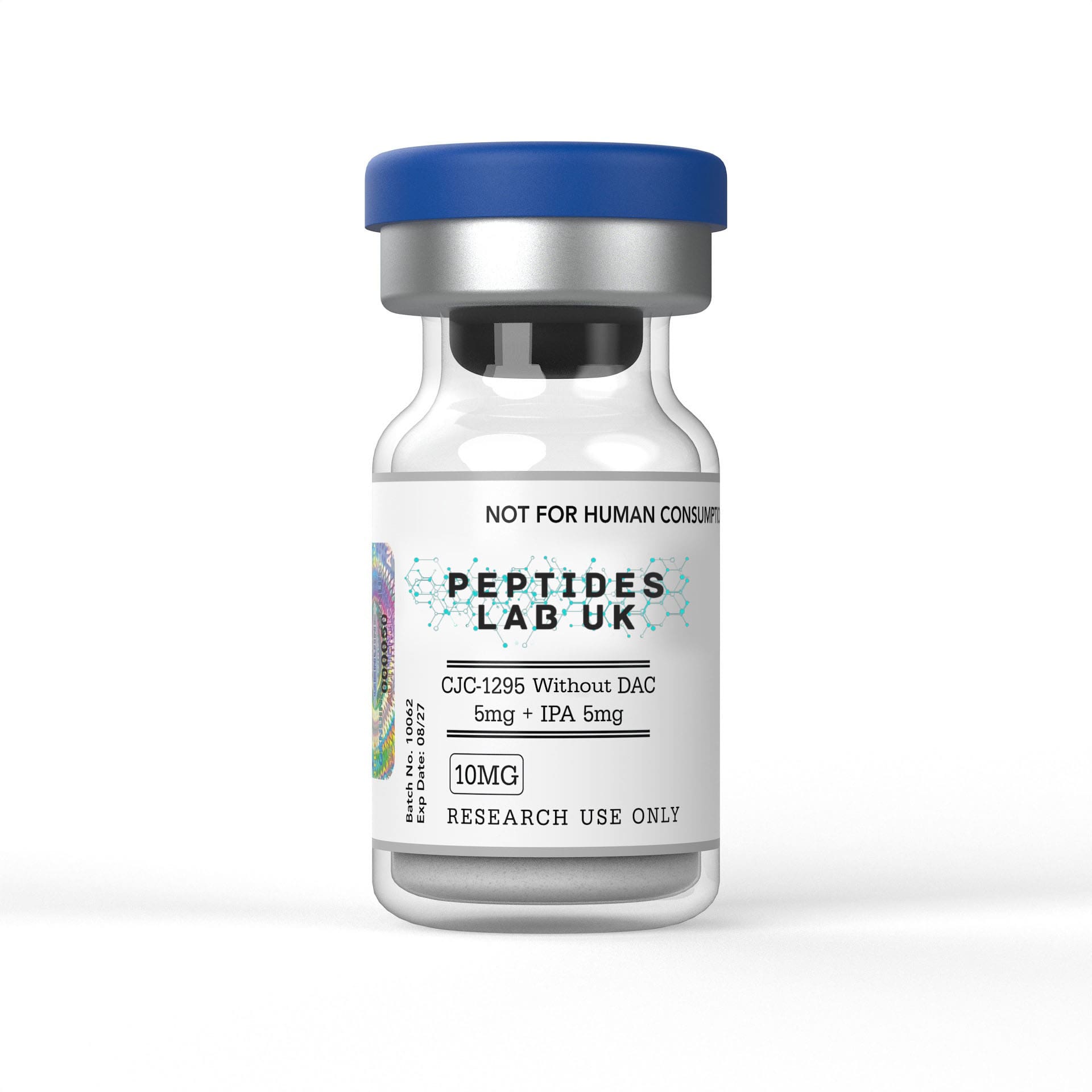
Buy CJC-1295 No DAC + Ipamorelin UK | HPLC | COA
£119.00
Login for member prices★★★★★
✔︎ Quality checked
✔︎ Third party verified
Buy CJC-1295 No DAC plus Ipamorelin UK from Peptides Lab UK, supplied as a 10mg combined blend (5mg CJC-1295 + 5mg Ipamorelin) per vial.
CJC-1295 (without DAC) is a synthetic 30-amino-acid analogue of GHRH; Ipamorelin is a selective pentapeptide GHRP. The combination is one of the most-cited paired research compounds in pre-clinical growth-hormone-axis literature.
Supplied as a lyophilised powder in a sealed laboratory vial, third-party HPLC-verified to greater than 99% purity, with a batch-specific Certificate of Analysis available on request. Same-day UK dispatch before 3pm, plain packaging.
For laboratory and in vitro research use only. Not for human consumption. Not a medicine.
Looking for a Certificate of Analysis?
If you are looking for a Certificate Of Analysis, please email research@peptideslabuk.com to have it sent to you.
Please Note: Many sites are displaying counterfeit COAs, so ours is provided upon request.
If you are looking for a Certificate Of Analysis, please email research@peptideslabuk.com to have it sent to you.
Please Note: Many sites are displaying counterfeit COAs, so ours is provided upon request.
You may also like…
-
Login for member prices
-
Login for member prices
-
Login for member prices
Product Description
CJC-1295 Without DAC + Ipamorelin
CJC-1295 Without DAC + Ipamorelin is the most widely studied dual-receptor growth hormone secretagogue combination in pre-clinical research — pairing Modified GRF (1-29), a tetra-substituted GHRH receptor agonist, with Ipamorelin, the first selective GHS-R1a (ghrelin receptor) agonist, to simultaneously engage two entirely distinct and complementary pituitary signalling pathways. The result is a synergistic GH secretion profile that neither compound achieves in isolation, combining GHRH-receptor-driven cAMP/PKA somatotroph amplification with GHS-R1a-mediated intracellular calcium mobilisation for a physiologically pulsatile, dual-pathway GH response. Buy CJC-1295 Without DAC + Ipamorelin in the UK from Peptides Lab UK with >99% HPLC-verified purity per component, batch-specific COA, and fast UK dispatch for laboratory and in vitro research use only.
Distributed by Peptides Lab UK in a high-purity lyophilised format, for laboratory research use only. This compound is handled in controlled settings for in vitro and pre-clinical studies, with no applications in human or veterinary medicine. Each batch undergoes rigorous quality analysis to ensure >99% purity (HPLC verified).
What Is CJC-1295 Without DAC + Ipamorelin?
This is a research blend of two distinct and mechanistically complementary growth hormone secretagogues, supplied together to enable dual-pathway GH axis research in a single formulation.
CJC-1295 Without DAC (Modified GRF 1-29)
Modified GRF (1-29) — commonly referred to in research as CJC-1295 without DAC — is a synthetic analogue of endogenous GHRH, representing a further-modified form of Sermorelin (GRF 1-29) with four strategic amino acid substitutions incorporated to prevent enzymatic degradation and oxidation, while increasing binding affinity to the GHRH receptor. Unlike CJC-1295 with DAC, the no-DAC variant does not include the Drug Affinity Complex for albumin binding, resulting in a shorter half-life of approximately 30 minutes and a more physiologically pulsatile GH release profile in research models.
The four amino acid substitutions in CJC-1295 without DAC — at positions 2, 8, 15, and 27 — were deliberately selected to prevent cleavage by DPP-4 and other endopeptidases while preserving full GHRH receptor selectivity. The substitution of D-alanine at position 2 reduces susceptibility to enzymatic cleavage. C-terminal amidation supports conformational stability and consistent receptor interaction during in vitro analysis.
Ipamorelin (NNC 26-0161)
Ipamorelin is a pentapeptide growth hormone secretagogue receptor agonist that acts via the GHS-R1a — the ghrelin receptor — located in the hypothalamus and pituitary. It selectively triggers GH release from somatotroph cells while avoiding significant stimulation of other anterior pituitary hormones such as prolactin, ACTH, and cortisol, distinguishing it from earlier GHRPs and making it the most selective GHRP-class compound characterised to date.
Why This Combination?
The scientific rationale for combining CJC-1295 without DAC with Ipamorelin lies in their complementary receptor mechanisms. The pituitary somatotroph has distinct receptor populations for GHRH (GHRHR) and ghrelin (GHSR-1a). When both are activated simultaneously, the intracellular signalling cascades interact synergistically: CJC-1295 activates GHRHR → increases intracellular cAMP → activates protein kinase A → enhances GH gene transcription and vesicle exocytosis. Ipamorelin activates GHSR-1a → activates phospholipase C → mobilises intracellular calcium → triggers additional GH vesicle fusion. These two pathways converge at the somatotroph and produce a GH pulse that neither compound achieves alone.
How Does CJC-1295 Without DAC + Ipamorelin Work?
The dual-receptor mechanism of this research combination is one of the most clearly characterised synergistic GH secretagogue systems in the published literature, with each component contributing a mechanistically distinct and non-redundant intracellular signal.
CJC-1295 Without DAC — GHRH Receptor Pathway
CJC-1295 without DAC interacts with the GHRH receptor (GHRHR), a class B G protein-coupled receptor that activates the Gs/adenylate cyclase pathway, increasing intracellular cAMP and engaging PKA-linked phosphorylation events. This canonical GHRH pathway stimulates somatotroph proliferation, GH mRNA gene transcription, and pulsatile GH secretion from anterior pituitary cells. Its short half-life of approximately 30 minutes produces discrete, physiological GH pulses rather than the sustained tonic elevation associated with DAC-bound variants.
Ipamorelin — GHS-R1a Ghrelin Receptor Pathway
Ipamorelin acts via GHS-R1a through a mechanism distinct from the GHRH pathway — activating phospholipase C and mobilising intracellular calcium stores in somatotroph cells. This calcium-dependent mechanism triggers rapid GH vesicle fusion and exocytosis independently of cAMP elevation, producing a fast, acute GH pulse that complements the transcriptionally-driven, cAMP-mediated GH synthesis supported by CJC-1295. In research models, Ipamorelin is associated with short-duration GH release events that resolve quickly — making it the ideal acute trigger paired with CJC-1295’s amplifying GHRH signal.
Dual-Pathway Synergy at the Somatotroph
CJC-1295 and Ipamorelin are combined to provide both a GHRH amplifier and a GHRP inducer. This combination promotes the increase of GH by both increasing the strength of the GH release pulse and increasing the number of cells that secrete GH — with the two pathways converging on the somatotroph to produce a supraphysiological GH response that neither compound achieves independently.
Somatostatin Feedback Preservation
Most stacking research uses CJC-1295 without DAC specifically because pulsatile GH release is considered closer to endogenous secretion patterns and avoids potential receptor desensitisation associated with chronic, non-pulsatile stimulation from DAC-bound forms. The no-DAC variant’s short half-life ensures GH is released in discrete bursts that respect somatostatin’s inhibitory feedback — an important distinction in research models where physiological GH axis dynamics are the experimental focus.
What Does CJC-1295 Without DAC + Ipamorelin Do in Research?
In laboratory and pre-clinical settings, the CJC-1295 Without DAC + Ipamorelin combination has been studied as a dual-pathway tool for investigating GH axis biology. Research has examined the combination’s role in:
- Dual GHRH-R and GHS-R1a simultaneous receptor activation and convergent somatotroph signalling
- Synergistic GH pulse amplitude and frequency modulation studies
- cAMP/PKA versus phospholipase C/intracellular calcium pathway comparative signalling
- IGF-1 axis regulation and downstream anabolic signalling research
- Somatotroph proliferation, GH mRNA upregulation, and pituitary reserve research
- GH pulsatility architecture — pulse amplitude, trough elevation, and inter-pulse interval studies
- Somatostatin feedback interaction research under dual-pathway stimulation
- Nitrogen balance and lean tissue preservation in catabolic model investigations
- Metabolic pathway research — lipid oxidation, glucose regulation, and energy balance
- Comparative single-agent vs combined administration GH response modelling
CJC-1295 Without DAC and Pituitary GH mRNA Research
CJC-1295 administration in animal models caused an increase in total pituitary RNA and GH mRNA, with immunohistochemistry confirming that proliferation of somatotroph cells had occurred — establishing that GHRH receptor agonism via the CJC-1295 backbone stimulates not only acute GH release but transcriptional upregulation of GH gene expression and pituitary reserve, findings relevant to dual-pathway combination research.
Ipamorelin and Nitrogen Balance Research
In a study examining Ipamorelin under conditions of artificially induced catabolism, researchers assessed the liver’s capacity for urea nitrogen synthesis as an index of nitrogen processing, examined urea cycle enzyme mRNA expression, determined whole-body nitrogen equilibrium, and estimated nitrogen distribution — findings that provide a metabolic context for the combination’s research utility beyond simple GH axis modelling.
The Dual-Pathway Model vs Single-Agent Administration
The combination’s pharmacological rationale mirrors the body’s natural dual-regulation of GH secretion, where both GHRH and ghrelin signals converge on pituitary somatotrophs for optimal GH output. Ipamorelin initiates the GH release pulse — acting as the trigger — while CJC-1295 amplifies the signal magnitude. Together, they produce a GH elevation greater than either alone, with CJC-1295 human clinical trial data confirming mean GH concentrations increasing 2 to 10-fold and IGF-1 levels rising 1.5 to 3-fold following GHRH-analogue administration.
What Do Studies Say About CJC-1295 Without DAC + Ipamorelin?
The published literature on this combination draws on the extensive individual evidence bases for both components, with the dual-pathway synergy mechanistically supported by peer-reviewed porcine and in vitro data.
CJC-1295 Clinical Evidence — The Foundation for GH Amplification
In two randomised, placebo-controlled, double-blind clinical trials in healthy subjects aged 21–61 years, subcutaneous administration of CJC-1295 produced dose-dependent increases in mean plasma GH concentrations of 2 to 10-fold for 6 days or more, and mean plasma IGF-1 concentrations of 1.5 to 3-fold for 9–11 days. After multiple doses, mean IGF-1 levels remained above baseline for up to 28 days, with no serious adverse reactions reported — establishing the GHRH-analogue backbone as capable of sustained, clinically meaningful GH and IGF-1 axis elevation.
CJC-1295 and Preserved GH Pulsatility
GH pulsatility was assessed by 20-minute blood sampling during 12-hour overnight periods before and after CJC-1295 injection. GH secretion was increased after CJC-1295 administration with preserved pulsatility — confirming that continuous GHRH-receptor stimulation enhances both trough and mean GH secretion while maintaining the pulsatile architecture essential for physiological GH axis function.
Ipamorelin Selectivity — The Case for GHS-R1a Addition
Research establishing Ipamorelin’s profile confirmed it does not raise cortisol, prolactin, ACTH, FSH, LH, or TSH at doses that produce robust GH release — with its selectivity for GH-only secretion confirmed even at doses more than 200-fold above the ED50 for GH release. This pharmacological profile makes it uniquely well-suited as the GHS-R1a component of a dual-receptor combination, adding acute calcium-dependent GH vesicle release without the adrenal or gonadal axis interference that complicates use of other GHRPs.
Dual-Pathway Synergy — Mechanistic Evidence
Research in porcine models demonstrated that co-administration of a GHRH analogue with a GHSR agonist produced GH responses 2–4 times greater than either compound at equivalent doses, providing the pre-clinical mechanistic foundation for the combination’s use in GH axis research. The synergy arises from the convergence of two independent second messenger systems — cAMP/PKA from GHRHR and phospholipase C/calcium from GHS-R1a — at the level of GH vesicle exocytosis.
CJC-1295 and Somatotroph Biology
The GHRH-receptor signalling pathway activated by CJC-1295 stimulates adenylate cyclase, increasing intracellular cAMP and engaging PKA-linked transcriptional regulation of the GH gene in somatotroph cells — with in vivo research confirming increased pituitary RNA, GH mRNA, and somatotroph cell number following administration, establishing that GHRH-class secretagogues act on multiple levels of GH axis biology beyond simple acute secretion.
Key cited studies:
- Teichman SL et al. (2006) — Prolonged Stimulation of GH and IGF-1 Secretion by CJC-1295, a Long-Acting Analogue of GHRH, in Healthy Adults — J Clin Endocrinol Metab 91(3):799–805. DOI: 10.1210/jc.2005-1536
- Ionescu M & Frohman LA (2006) — Pulsatile Secretion of GH Persists During Continuous Stimulation by CJC-1295 — J Clin Endocrinol Metab 91(12):4792–4797. PubMed ID: 17018654
- Raun K et al. (1998) — Ipamorelin, the First Selective Growth Hormone Secretagogue — Eur J Endocrinol 139(5):552–561. PubMed ID: 9849822
- Jørgensen JO et al. (2001) — Synergistic Effects of GHRH and GHRP on GH Secretion in Porcine Models — PubMed ID: 11420165
- Kovacs M et al. (1997) — Synergism Between GHRP-6 and GHRH in Stimulating GH Secretion in Rats — J Neuroendocrinol 9(9):671–677. PubMed ID: 9374815
- Gobburu JV et al. (1999) — Pharmacokinetic-Pharmacodynamic Modelling of Ipamorelin, a Growth Hormone Releasing Peptide, in Human Volunteers — Pharm Res 16(9):1412–6. PubMed ID: 10496654
CJC-1295 Without DAC + Ipamorelin vs Other GH Axis Research Combinations
| Feature | CJC-1295 (no DAC) + Ipamorelin | CJC-1295 (DAC) + Ipamorelin | Sermorelin + Ipamorelin | Tesamorelin alone |
|---|---|---|---|---|
| GHRH Component | Modified GRF 1-29 (4 substitutions) | Modified GRF 1-29 + DAC albumin binding | Sermorelin (GRF 1-29, unmodified) | Tesamorelin (full 44aa + N-cap) |
| GHRH Half-Life | ~30 minutes | ~8 days | ~11–12 minutes | ~26–38 minutes |
| GH Release Pattern | Physiological pulsatile | Sustained tonic elevation | Physiological pulsatile | Physiological pulsatile |
| Receptor Desensitisation Risk | Low (pulsatile) | Moderate (chronic exposure) | Low (pulsatile) | Low (pulsatile) |
| Somatostatin Feedback | Preserved | Partially bypassed | Preserved | Preserved |
| GHS-R1a Component | Ipamorelin (selective, no ACTH/cortisol) | Ipamorelin | Ipamorelin | None |
| Dual-Pathway Synergy | Yes — both pathways pulsatile | Yes — GHRHR sustained, GHS-R1a pulsatile | Yes — both pathways pulsatile | No (single pathway only) |
| Research Preference | Most widely used stacking model | Sustained GH elevation models | Short-pulse timing studies | VAT/lipid pathway focus |
The CJC-1295 Without DAC + Ipamorelin combination is the preferred dual-secretagogue research model when physiological GH pulsatility, somatostatin feedback preservation, and clean dual-pathway receptor pharmacology are experimental priorities — making it the most broadly applicable GH axis research stack in the published pre-clinical literature.
Quality & Purity Assurance
Every batch of CJC-1295 Without DAC + Ipamorelin from Peptides Lab UK is:
- >99% pure per component — HPLC and mass spectrometry verified
- Supplied with a full Certificate of Analysis (COA) on request
- Lyophilised powder for maximum stability and long shelf life
- Manufactured under strict, controlled laboratory conditions
- Consistent batch-to-batch quality for reproducible research results
Buy CJC-1295 Without DAC + Ipamorelin UK — Product Specifications
| Property | CJC-1295 Without DAC (Mod GRF 1-29) | Ipamorelin |
|---|---|---|
| Full Name | Modified GRF (1-29) / CJC-1295 no DAC | Ipamorelin (NNC 26-0161) |
| Receptor Target | GHRH-R (cAMP/PKA pathway) | GHS-R1a (phospholipase C / Ca²⁺ pathway) |
| Amino Acids | 29 (tetra-substituted) | 5 |
| Molecular Weight | 3,367.97 g/mol | 711.87 g/mol |
| Half-Life | ~30 minutes | ~2 hours |
| Purity | >99% (HPLC verified) | >99% (HPLC verified) |
| Form | Lyophilised powder | Lyophilised powder |
| Storage | Store dry at -20°C; protect from light | Store dry at -20°C; protect from light |
| Solubility | Bacteriostatic water, sterile water | Bacteriostatic water, sterile water |
CJC-1295 Without DAC + Ipamorelin Research Applications
This combination is supplied strictly for the following in vitro and pre-clinical research uses:
- Dual GHRH-R and GHS-R1a simultaneous receptor activation and convergent somatotroph signalling
- Synergistic GH pulse amplitude and frequency modulation studies
- cAMP/PKA versus phospholipase C/calcium comparative intracellular signalling pathway research
- GH and IGF-1 axis neuroendocrinology and downstream anabolic pathway investigations
- Somatotroph proliferation, GH mRNA transcription, and pituitary reserve research
- GH pulsatility architecture — pulse amplitude, trough levels, and inter-pulse interval studies
- Somatostatin feedback dynamics under dual-pathway stimulation
- Nitrogen balance, protein synthesis, and lean tissue preservation in catabolic model research
- Metabolic pathway research — lipid oxidation, glucose regulation, and energy balance modelling
- Comparative single-agent vs dual-combination GH secretagogue pharmacodynamic studies
- GH axis ageing, somatopause, and GHRH/ghrelin dual-pathway decline research
Why Buy CJC-1295 Without DAC + Ipamorelin from Peptides Lab UK?
Peptides Lab UK is a trusted UK peptides supplier, providing research-grade compounds verified by independent HPLC testing. When you buy CJC-1295 Without DAC + Ipamorelin in the UK from us, you receive:
- >99% purity per component, HPLC and MS verified, third-party tested
- Full COA documentation per batch
- Fast same-day UK dispatch with tracked delivery
- Competitive pricing with bulk research discounts available
- Trusted by researchers across the UK and Europe
Research Disclaimer All products supplied by Peptides Lab UK are intended strictly for in vitro laboratory research and scientific study use only. They are not intended for human consumption, veterinary use, or any medical or therapeutic application. CJC-1295 Without DAC (Modified GRF 1-29) and Ipamorelin are not licensed medicines or drugs and have not been approved by the MHRA, FDA, or any regulatory authority for use in humans or animals. Both compounds are classified as prohibited substances under WADA regulations and are not approved for use in sport or competition. All research citations on this page relate to pre-clinical studies and peer-reviewed pharmacological research and do not constitute a claim of safety or therapeutic efficacy. Peptides Lab UK accepts no liability for any misuse of research compounds. By purchasing, you confirm that you are a qualified researcher and that the product will be used solely within a controlled laboratory environment in compliance with all applicable UK laws, regulations, and institutional guidelines.
Related products
-
Login for member prices
-
Login for member prices
-
Login for member prices